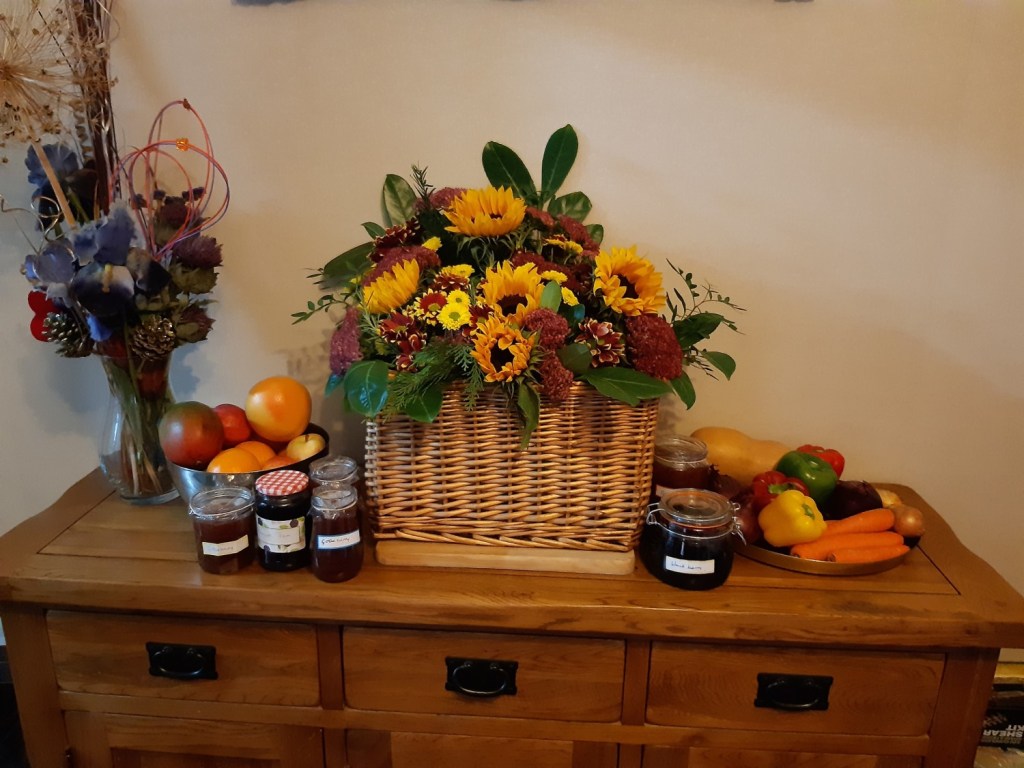
Harvest Festival

Opening Hymn

Readings

2 Corinthians 9:6-end

Remember this—a farmer who plants only a few seeds will get a small crop. But the one who plants generously will get a generous crop. You must each decide in your heart how much to give. And don’t give reluctantly or in response to pressure. “For God loves a person who gives cheerfully.” And God will generously provide all you need. Then you will always have everything you need and plenty left over to share with others. As the Scriptures say,

“They share freely and give generously to the poor.
    Their good deeds will be remembered forever.”

10 For God is the one who provides seed for the farmer and then bread to eat. In the same way, he will provide and increase your resources and then produce a great harvest of generosity in you.

11 Yes, you will be enriched in every way so that you can always be generous. And when we take your gifts to those who need them, they will thank God. 12 So two good things will result from this ministry of giving—the needs of the believers in Jerusalem will be met, and they will joyfully express their thanks to God.

13 As a result of your ministry, they will give glory to God. For your generosity to them and to all believers will prove that you are obedient to the Good News of Christ. 14 And they will pray for you with deep affection because of the overflowing grace God has given to you. 15 Thank God for this gift too wonderful for words!

Luke 12:16-30

16 Then he told them a story: “A rich man had a fertile farm that produced fine crops. 17 He said to himself, ‘What should I do? I don’t have room for all my crops.’ 18 Then he said, ‘I know! I’ll tear down my barns and build bigger ones. Then I’ll have room enough to store all my wheat and other goods. 19 And I’ll sit back and say to myself, “My friend, you have enough stored away for years to come. Now take it easy! Eat, drink, and be merry!”’

20 “But God said to him, ‘You fool! You will die this very night. Then who will get everything you worked for?’

21 “Yes, a person is a fool to store up earthly wealth but not have a rich relationship with God.”

22 Then, turning to his disciples, Jesus said, “That is why I tell you not to worry about everyday life—whether you have enough food to eat or enough clothes to wear. 23 For life is more than food, and your body more than clothing. 24 Look at the ravens. They don’t plant or harvest or store food in barns, for God feeds them. And you are far more valuable to him than any birds! 25 Can all your worries add a single moment to your life? 26 And if worry can’t accomplish a little thing like that, what’s the use of worrying over bigger things?

27 “Look at the lilies and how they grow. They don’t work or make their clothing, yet Solomon in all his glory was not dressed as beautifully as they are. 28 And if God cares so wonderfully for flowers that are here today and thrown into the fire tomorrow, he will certainly care for you. Why do you have so little faith?

29 “And don’t be concerned about what to eat and what to drink. Don’t worry about such things. 30 These things dominate the thoughts of unbelievers all over the world, but your Father already knows your needs

Homily

Happy Harvest – the Sunday of our year when we celebrate all that God has given us, and give gifts in return. For all its joy, it is a bit of a challenging Sunday for me as your vicar. I am not very good at preaching about giving. There are two reasons for this. The first reason is that I don’t think that I have my attitude to money and material belongings completely sorted, and so I worry about being a hypocrite. The apostle Paul says in one of his letters that he has learned to live contentedly with little and with plenty – I know I am not quite there yet. I could be more generous. I could be less anxious about stuff. I’ll come back to this in a moment.

My second reason is a bit more positive. I am so keen for people to know the abundant, freely offered love, forgiveness and grace of God, I worry that talking about giving will get in the way. God is a God of such generosity, and I long for people to know it to their very core. As the traditional harvest hymn puts it: For the beauty of the earth, for the glory of the skies, for the love which from our birth, over and around us lies. The beauty of creation, the love and life we experience – all this is a gift from the God who loves us so dearly, he would do anything to ensure we could experience that love. Even live among us, die for us, defeat death for us… To follow up this message of free, abundant and outrageous love with “and now, would you like a standing order form?” can feel a bit off.

But even though these are two good reasons, I am not doing my job if I don’t talk about giving from time to time. Giving out of all God has given to us is a fundamental part of being a Christian. It is no more an optional extra than prayer, or reading the Bible, or taking communion. There are many reasons why giving is so important to our Christian life, and I will explain three briefly now:

The first is that giving demonstrates faith. In our gospel, we have the farmer who puts his trust in bigger barns and hoarding all the good he had been given, but in the end he has missed the point. In this story, I don’t think Jesus is suggesting that money, clothes and food don’t matter, but rather that they are not what matter most. Our relationship with the God that loves us and our relationships with one another are at that heart of what it is to be human. Giving – sharing what we can with others instead of hoarding for ourselves – demonstrates our trust in the God who provides for us and help us to keep our priorities right. Relationship over riches.

The second is that in giving generously, we become more like the children of God we are called to be. God is a God who gives abundantly. God’s children are in the family business, so we too should give where we can. I don’t know how many of you have younger children in your family or extended family. There is nothing that melts an adult’s heart like one of the children they adore choosing to be generous to another person. Seeing the little person you love learning to show love to others is a huge joy. We bring such joy to God when we share what we can with one another. In our first reading, Paul argues that as we do this, God will send us more opportunities to share and show love to each other. We will develop generous hearts that echo the generous heart of our God.

The third reason is that in our acts of generosity, we help others see God. In these days of direct debits and standing orders, we are sometimes disconnected from the outcomes of our giving, but they are there nonetheless. Some stressed and struggling person is going to be able to feed themselves and their family because of your generosity to our harvest appeal. Someone who just needs life to give them a break is going to be able to sit down with a cup of tea and a bourbon because someone from our church cared enough to pop some teabags, sugar and biscuits in their shopping this week. A refugee camp somewhere has a hygenic toilet block because of our Toilet Twinning appeal last year. Somewhere a community is a little better protected against climate change because of our Christian Aid fundraising. And across your community, during the heartache of covid, grieving families have had a priest to be with them and – when allowed – a building to welcome them on the saddest days of their lives because you faithfully give, week in week out, to enable the loving Christian ministry of this place. These things matter. Your giving enables someone to show God’s love in places where it is really needed.

St Paul’s is already a generous church – the table of provisions in our churchyard is a visible sign of that. This sermon is not to harangue anyone, but to encourage you at this time of gratitude, gifts and giving to remember again why we give at all – to show love is our priority, to bring God joy and to share God’s love. It is also – in the light of all those important reasons – an invitation to you to think about your own giving. Maybe this is something you do regularly. Maybe this is the first time someone has suggested it. But, for many of us – me included as I admitted at the start – this is an area of our life which needs a little tweaking from time to time. For some of us, circumstances have changed and we need to give less, and that is okay. Please don’t feel guilty if that is you right now! But for others of us, if we look at our bank statement, it may come as a shock to discover we give less to church and charities than we do to Costa and it might be a time to rebalance things in ways that show what is truly important to us.

So at this time of giving, may we rejoice again in all God has given us and commit ourselves afresh to living as generously and joyfully as we can, sharing God’s love with all.

Prayers

As we celebrate and give thanks for our blessings at Harvest, this prayer helps us also to remember those who do not have such good things.

When we hear the gentle sound of the rain watering the earth,
help us to remember the thirst of those whose land is dry.

When we feel the warmth of the Sun on our faces,
help us to remember the plight of those locked away in darkness.

When we buy the fruit of the world’s harvest,
help us to remember the hunger of those whose basket is empty.

When we enjoy the ease of communicating around the world,
help us to remember those who are isolated from their friends.

When we relax in times of holiday,
help us to remember those who have to work without ceasing.

When we celebrate our blessings at harvest time,
help us remember those who experience disaster.

May our remembering reactivate our conscience
and result in a renewed commitment to Christ in our neighbour.


Amen.

(From rootsontheweb.com)

Closing Hymn

Pressing on

Adventure, Backpack, Cliff, Hiker
Image: Pixabay

Hymn

Bible Reading

Philippians 3:4b-14

Indeed, if others have reason for confidence in their own efforts, I have even more!

I was circumcised when I was eight days old. I am a pure-blooded citizen of Israel and a member of the tribe of Benjamin—a real Hebrew if there ever was one! I was a member of the Pharisees, who demand the strictest obedience to the Jewish law. I was so zealous that I harshly persecuted the church. And as for righteousness, I obeyed the law without fault.

I once thought these things were valuable, but now I consider them worthless because of what Christ has done. Yes, everything else is worthless when compared with the infinite value of knowing Christ Jesus my Lord. For his sake I have discarded everything else, counting it all as garbage, so that I could gain Christ and become one with him. I no longer count on my own righteousness through obeying the law; rather, I become righteous through faith in Christ.[c] For God’s way of making us right with himself depends on faith. 10 I want to know Christ and experience the mighty power that raised him from the dead. I want to suffer with him, sharing in his death, 11 so that one way or another I will experience the resurrection from the dead!

Pressing toward the Goal

12 I don’t mean to say that I have already achieved these things or that I have already reached perfection. But I press on to possess that perfection for which Christ Jesus first possessed me. 13 No, dear brothers and sisters, I have not achieved it,[d] but I focus on this one thing: Forgetting the past and looking forward to what lies ahead, 14 I press on to reach the end of the race and receive the heavenly prize for which God, through Christ Jesus, is calling us.

Homily

Pressing onwards can feel hard can’t it. there is a sense in the very phrase that this is no easy stroll in the park but that it involves effort and perseverance. Six months have passed since the original lockdown in March, and there seems to be no end in sight to the coronavirus crisis. It feels like hard work just going about daily life. Whilst physical and emotional endurance like this was part of St Paul’s struggle, his main concern is about pressing on in faith. He lists all of his religious credentials before saying these are not enough. Its the attitude of our hearts that matters. How we run our race and how we help ourselves to endure are really important.

I wonder what things help you in your faith journey. They might be traditional things such as worship like this or following daily bible readings or prayers, but they could just as easily be more creative things, perhaps art or poetry or reading or walking. The important thing is not so much what we do but ensuring that we do the things that sustain us and help us to endure in our faith journey. Perhaps you might like to share in the comments some of those things that help you. Remember we are all different and different things will sustain different people – just as some people will find a cathedral choir uplifting, while others will prefer a worship band, neither is better, each help nourish faith.

Maybe take some time out this week to work out what it is that nourishes your faith and see if you can find some time to do it, or maybe try something new and see if it helps you experience worship in a new way. Whatever it is I pray God’s blessings on the journey for you.

Prayers

Adapted from the prayer of the Pilgrim of St James.

O God, who brought your servant Abraham out of the land of the Chaldean’s, protecting him in his wanderings, who guided the Hebrew people across the desert, we ask that you watch over us, your servants, as we walk in the love of your name.  Be for us our companion on the walk, Our guide at the crossroads, Our breath in our weariness, Our protection in danger, Our refuge along the way, Our shade in the heat, Our light in the darkness, Our consolation in our discouragements, And our strength in our intentions.  So that with your guidance we may arrive safe and sound at the end of the Road and enriched with grace and virtue and filled with joy.  In the name of Jesus Christ our Lord,  Amen. 

Hymn

Justice

Image: Pixabay

Hymn

Bible reading

Ezekiel 18:1-4, 25-end. 

18 Then another message came to me from the Lord: “Why do you quote this proverb concerning the land of Israel: ‘The parents have eaten sour grapes, but their children’s mouths pucker at the taste’? As surely as I live, says the Sovereign Lord, you will not quote this proverb anymore in Israel. For all people are mine to judge—both parents and children alike. And this is my rule: The person who sins is the one who will die…

 25 “Yet you say, ‘The Lord isn’t doing what’s right!’ Listen to me, O people of Israel. Am I the one not doing what’s right, or is it you? 26 When righteous people turn from their righteous behavior and start doing sinful things, they will die for it. Yes, they will die because of their sinful deeds. 27 And if wicked people turn from their wickedness, obey the law, and do what is just and right, they will save their lives. 28 They will live because they thought it over and decided to turn from their sins. Such people will not die. 29 And yet the people of Israel keep saying, ‘The Lord isn’t doing what’s right!’ O people of Israel, it is you who are not doing what’s right, not I.

30 “Therefore, I will judge each of you, O people of Israel, according to your actions, says the Sovereign Lord. Repent, and turn from your sins. Don’t let them destroy you! 31 Put all your rebellion behind you, and find yourselves a new heart and a new spirit. For why should you die, O people of Israel? 32 I don’t want you to die, says the Sovereign Lord. Turn back and live!

Homily

Both of today’s readings are a bit heavy. Our reading from Ezekiel talking about judgement each according to their actions and our Gospel reading which speaks of Jesus being aware he will be betrayed. Its all a bit heavy going, so why are the people who write the liturgy encouraging us to think about these things?

Well I think firstly the principle to underline is that God is a just God. Note that in our Ezekiel reading there is a punishment for doing “sinful things” but also that those who stop doing those things turn around and start behaving well, will save themselves. In other words, it is proportionate and merciful. Why is there judgement though you may say? I find it helpful to think of judgement as being about the fairness of God. Its always hard if we think about it relating to ourselves or for small things but what about the big things? Surely if someone mugs another person and gets away with it you would like to think they would face the consequences one day, but also that if they were sorry and made amends that they could be forgiven. I think this is a bit like that.

Over the summer I started reading the bible in a year. I am now into Deuteronomy, but one of the things I noticed from all the laws in Leviticus for example, is that they are all about proportionality. If someone steals your goat, you should get a goat back, but if you go and kill them and their family for stealing your goat that is disproportionate and would be sinful. In a part of the world and at a time when people made their own justice this was hugely important to stop things escalating out of all proportion. If we can trust that God ultimately is judge over all we can leave our injustices to God to resolve fairly rather than resorting to our own justice.

Judgement isn’t very fashionable to talk about, but it is important, as anyone who has been a victim of crime or some other injustice will know. We cry out for the right thing to happen. It doesn’t change it but knowing that there are consequences to our actions gives the victim some comfort. Then we turn to look at the other side of this, which is that God forgives the person who is repentant. This isn’t dispassionate justice metered out, rather it is compassionate justice edged with mercy and forgiveness. In other words when we screw up and get things wrong God gives us every chance to put things right again.

As we reflect on this and we remember the mercy of God towards us, it is perhaps helpful to use it a prompt to pray for all those things that are unjust in our world. The problems which we as individuals have very little say over, but which we can entrust to God, remembering that God is a God of mercy as well as justice, of Judgement as well as compassion.

Prayers

As we take time to pray and draw to mind those ways we too have sinned you might find this short liturgy helpful. As we remember God’s mercy towards us then we can turn to asking God to help us be merciful towards others. After praying through this liturgy you might find it useful to spend a short time in prayer, praying for those you struggle to forgive, or praying for justice in the world.

The Lord is full of compassion and mercy,

All   slow to anger and of great kindness.

He has not dealt with us according to our sins,

All   nor rewarded us according to our wickedness.

For as the heavens are high above the earth,

All   so great is his mercy upon those who fear him.

Silence is kept for reflection.

All   Holy God,

holy and strong,

holy and immortal,

have mercy upon us.

As far as the east is from the west,

All   so far has he set our sins from us.

As a father has compassion on his children,

All   so is the Lord merciful towards those who fear him.

Bless the Lord, O my soul,

All   and all that is within me bless his holy name.

Bless the Lord, O my soul,

All   and forget not all his benefits.

Hymn

It’s not fair!

Dove, Bird, Nature, Peace, White, Hope
Image: Pixabay

Bible reading

Jonah 3:10-4:11

10 When God saw what they had done and how they had put a stop to their evil ways, he changed his mind and did not carry out the destruction he had threatened.

Jonah’s Anger at the Lord’s Mercy

This change of plans greatly upset Jonah, and he became very angry. So he complained to the Lord about it: “Didn’t I say before I left home that you would do this, Lord? That is why I ran away to Tarshish! I knew that you are a merciful and compassionate God, slow to get angry and filled with unfailing love. You are eager to turn back from destroying people. Just kill me now, Lord! I’d rather be dead than alive if what I predicted will not happen.”

The Lord replied, “Is it right for you to be angry about this?”

Then Jonah went out to the east side of the city and made a shelter to sit under as he waited to see what would happen to the city. And the Lord God arranged for a leafy plant to grow there, and soon it spread its broad leaves over Jonah’s head, shading him from the sun. This eased his discomfort, and Jonah was very grateful for the plant.

But God also arranged for a worm! The next morning at dawn the worm ate through the stem of the plant so that it withered away. And as the sun grew hot, God arranged for a scorching east wind to blow on Jonah. The sun beat down on his head until he grew faint and wished to die. “Death is certainly better than living like this!” he exclaimed.

Then God said to Jonah, “Is it right for you to be angry because the plant died?”

“Yes,” Jonah retorted, “even angry enough to die!”

10 Then the Lord said, “You feel sorry about the plant, though you did nothing to put it there. It came quickly and died quickly. 11 But Nineveh has more than 120,000 people living in spiritual darkness,[a] not to mention all the animals. Shouldn’t I feel sorry for such a great city?”

It’s not fair!

We have an inbuilt sense of justice. It’s not fair I cry as a child when the slightest injustice seems to occur, but the thing is we don’t really grow out of it… We have a sense that the world should be fair, even when blatantly much of the time it seems not to be. It’s not fair I think to myself, envious that they have more or better than me… whatever ‘more’ it might be that is preoccupying me at that time.

I love this reading from Jonah because it’s so real! He we have Jonah who according to the story so didn’t want to go and proclaim God’s word that he ran away in the opposite direction, nearly drowned and was rescued by a huge fish, so grumpily he goes on his mission and frankly in our reading today he is sulking. He has said as God commanded him, yet he knows enough of God to remember that he is merciful – I think being rescued by a fish probably taught him that! So, he knows that if the people repent, which they did, then the destruction promised won’t materialise – and he is grumpy. I wonder why this is? After all the people took notice of him, he told them God’s message to repent and they did. Perhaps he wondered what the point was of his message, perhaps he wanted to see God reign down destruction on his say so, perhaps he was just a reluctant prophet having a bad day?! Who knows?

What’s interesting is that God doesn’t leave him there to sit and sulk, he isn’t angry with him, instead he teaches him about grace. He sends a bush to grow and shade him, which Jonah loves, then removes it – here is grace, a blessing given, but then taken again at God’s will. Now of course this makes Jonah even more cross, but in doing so God is showing him what mercy is like – in the shade of the bush, and how unpleasant it is to live in a world without mercy, when the bush dies. And of course this is tiny in comparison to God’s compassion for Nineveh, and his mercy on that city.

We don’t know if this taught Jonah his lesson. If he stopped sulking and learnt a bit about the mercy of God that day. But it did make me wonder if rather than titling this ‘its not fair’ whether ‘Outrageous grace’ might have been a better title. I wonder what things in life are making you want to yell out its not fair to God? Of course there is much injustice in the world that is very definitely not fair… but if we are honest like Jonah there are times when we too cry its not fair, when really all we have is our own selfish interest at heart. Perhaps today you are feeling a bit grumpy with God? Well its ok to take that to him. This story shows how merciful God is with his followers, how gently he sets us on the right path. Or maybe there is something that God is using at the moment to teach you of his Grace. Maybe now is the time to step back and take notice and give thanks. We don’t know how Jonah responded to God’s grace, but we can each determine how we respond to it.

Take some time to bring your grumbles to God and ask that in mercy God might show you the meaning of outrageous grace.

Prayer

Try using the prayer of St Francis below as a way of reflecting on God’s grace and mercy, both how God shows it to us and how we can show it to others. Take time to pray it through slowly, several times reflecting on each line, bringing to mind the situations it mentions and any that are personal to you or that you think of in the news. For example; ‘Where there is hatred let me sow peace’ take some time to think of conflicts among those you know and abroad, think about how you can pray for peace in those situations.

Prayer of St Francis of Assisi

Lord, make me an instrument of your peace:
Where there is hatred, let me sow peace,
Where there is injury, let me sow pardon,
Where there is doubt, let me sow faith,
Where there is despair, let me give hope,
Where there is darkness, let me give light,
Where there is sadness, let me give joy.
O Divine Master, grant that I may
Not try to be comforted, but comfort,
Not try to be understood but to understand,
Not try to be loved but to love.
Because it is in the giving that we receive
It is in the forgiving that we are forgiven
And it is in the dying that we are born to eternal life.

Forgiveness

Excuse Me, Sorry, Smiley, Cute
image: Pixabay

Hymn

Bible reading: Matthew 18:21-35

Parable of the Unforgiving Debtor

21 Then Peter came to him and asked, “Lord, how often should I forgive someone who sins against me? Seven times?”

22 “No, not seven times,” Jesus replied, “but seventy times seven!

23 “Therefore, the Kingdom of Heaven can be compared to a king who decided to bring his accounts up to date with servants who had borrowed money from him. 24 In the process, one of his debtors was brought in who owed him millions of dollars. 25 He couldn’t pay, so his master ordered that he be sold—along with his wife, his children, and everything he owned—to pay the debt.

26 “But the man fell down before his master and begged him, ‘Please, be patient with me, and I will pay it all.’ 27 Then his master was filled with pity for him, and he released him and forgave his debt.

28 “But when the man left the king, he went to a fellow servant who owed him a few thousand dollars. He grabbed him by the throat and demanded instant payment.

29 “His fellow servant fell down before him and begged for a little more time. ‘Be patient with me, and I will pay it,’ he pleaded. 30 But his creditor wouldn’t wait. He had the man arrested and put in prison until the debt could be paid in full.

31 “When some of the other servants saw this, they were very upset. They went to the king and told him everything that had happened. 32 Then the king called in the man he had forgiven and said, ‘You evil servant! I forgave you that tremendous debt because you pleaded with me. 33 Shouldn’t you have mercy on your fellow servant, just as I had mercy on you?’ 34 Then the angry king sent the man to prison to be tortured until he had paid his entire debt.

35 “That’s what my heavenly Father will do to you if you refuse to forgive your brothers and sisters from your heart.”

Homily

I don’t know how many of you use social media – Facebook, Instagram, Twitter, and so on.  I despair when the conversations get so toxic, just because people don’t agree with each other.  The social media world is not a grey area when it comes to different opinions.  Measured discussion is not possible when character numbers are limited and so people turn to the lowest common denominator – trading insults instead of viewpoints. And yet I continue to use these platforms because there are people out there that I look up to, like to have a conversation with, or even, sometimes, disagree with, but what I hope is in a measured way.  Certainly, I have never been blocked or unfriended by anyone because of a differing opinion.  I have also had some good conversations and shared information, opinion and recommendations with a number of people, some famous, some not.  Surely this is how we should discuss matters on social media, not drive people to insult?  As we have seen in the news all too often, such insults can lead to tragic consequences.

We use a significant amount of words each and every day, mainly for conversations with our family, friends and colleagues, and for the most part these words are cordial and allow for the exchange of information. But there are times when words are used in divisive or unhelpful ways, and often these can cut to the core of a person, or worse when they are used to condemn someone to a third party, specially where there has been some sort of disagreement.

These words may make the person who has been upset feel better for a moment as they vent their anger or frustration, but, very soon, this action becomes an empty act and that is where the danger sets in where the process is repeated time and time again. Without realising it the person has sullied someone else to a number of people, and all without the subject of the conversation being aware that this has happened, well until the point when the conversation comes back, and the damage has been done, namely their character has been defamed, or slandered.  I am sure we have all experienced this in one form or another and know how we felt or even feel.  We can be victims of a disagreement and gossip and not know how to solve the issue.

We can also deliberately or otherwise, cause the argument, disagreement or gossip and maybe a situation can get out of hand and what starts as a disagreement with another person is blown out of all proportion, and we are guilty of doing exactly what Paul is talking about in our epistle this morning. We have cast a judgement on another because their view is opposed to our own.

It’s a dangerous road to travel, and causes hurt and pain for everyone involved. However, to really see the consequences we need to turn our attention towards todays Gospel.

Peter was asking about forgiveness, and Christ begins by saying seventy-seven times, and then tells a parable. At the beginning it looks like a story about charity and the generosity of the king who forgave the slave such a great debt. But as it continues it very quickly becomes sour as the slave who has just been freed from a massive debt persecutes a fellow slave who in comparison owed him pittance.

The story quickly unfolds and the king learns about the deplorable way that the slave has acted, and as a result he finds himself in custody with the debt firmly around his neck and now due for full payment.

Forgiveness for all of us is a difficult concept, usually when we are wronged, what we want to do is retaliate, he or she did this to me, I’m going to repay them by doing this. The fire of anger enrages us, and if we are being honest it is highly unlikely that the first thing on our mind is repentance.

But of course, in doing this we have cast judgement onto them.  We know we are right and they are wrong.  It eats away at us and it can cause wider hurt and splits in communities as we gather supporters and polarize our opinions and entrench our positions.  This section of Paul’s letter to the Romans is not the only time he is trying to heal rifts in the congregations he is keeping in contact with.  His letters have many such examples.

We should continue to listen to St Paul and take note of what he says here and elsewhere. Earlier in his letter to the Romans he said, “Bless those who persecute you; bless and do not curse them. Rejoice with those who rejoice, weep with those who weep. Live in harmony with one another; do not be haughty, but associate with the lowly; do not claim to be wiser than you are. Do not repay anyone evil for evil, but take thought for what is noble in the sight of all. If it is possible, so far as it depends on you, live peaceably with all.”

We need to remember that in forgiveness there are three parties: the one who has been hurt, the one who caused the pain and God

You see there may be a time when the one who had caused the hurt comes to apologise, and if that is heartfelt and truthful, then we are taught that we should forgive, just as we have been forgiven. If we do that then our relationship with God remains true.

But what if we refuse to forgive? This causes issues for us, because none of us are perfect, and as we would want to be forgiven for things we have done, then we must also do the same.

However, there is one more aspect which we often don’t think about, and that is what if the one who has caused the hurt doesn’t come to apologise? This is possibly the hardest scenario, because the pain that we feel has no outlet, and if we’re not careful then it can consume us, it can remain an open wound which can become infected. It is at this point that we have to come to a place where we find forgiveness for their actions in our hearts, so that we can move on.  As I said earlier, it can eat away at us and this can lead to many negative thoughts which can hurt us even more.

It may sound strange to say this, but consider the words of The Lord’s Prayer, “And forgive us our trespasses, as we forgive those who trespass against us.”

Notice how the words are focussed on us, our reaction to what is happening, not on what another person has or hasn’t done.  The prayer asks that God sees that we keep our relationship right with Him. It is up to the other person to take the necessary steps to make themselves right with God, that is not our responsibility. Our responsibility if we are the one who has been hurt, is to ensure that if restitution is offered, that we have found that peace, and come to a place where that gift of forgiveness can be offered, just as it is offered to us by God, freely and with grace.

C S Lewis said “To be a Christian means to forgive the inexcusable because God has forgiven the inexcusable in you”

Social media shows how the world expects us to condemn others; to trade insults. To do otherwise is counter-cultural and there are many in the world who cannot accept that there is another way, a better way. Christ and St Paul remind us today that there is a better way, and as we pray the Lord’s prayer, perhaps it’s time to shed that pain and hurt which has been eating away at us, forgiving others as He forgives us. Amen.

Prayers

You might find this form of penitential prayer from the Church of England helpful. It can be said alone and reminds us of the call to forgive. You might find it helpful to say all the words out loud, and perhaps to return to it several times as you search your heart and seek God’s forgiveness and learn to forgive others.

A candle may be lit and silence may be kept.

Come, Holy Spirit of God,

All   and search our hearts with the light of Christ.

Our Lord Jesus Christ said:

The first commandment is this:

‘Hear, O Israel, the Lord our God is the only Lord.

You shall love the Lord your God with all your heart,

with all your soul, with all your mind,

and with all your strength.’

The second is this: ‘Love your neighbour as yourself.’

There is no other commandment greater than these.

On these two commandments hang all the law and the prophets.

All   Amen. Lord, have mercy.

After a period of reflection

Come, let us return to the Lord and say:

All   Lord our God,

in our sin we have avoided your call.

Our love for you is like a morning cloud,

like the dew that goes away early.

Have mercy on us;

deliver us from judgement;

bind up our wounds and revive us;

in Jesus Christ our Lord.

Amen.

May almighty God,

who sent his Son into the world to save sinners,

bring us his pardon and peace, now and for ever.

All   Amen.

Hymn

Creationtide

sun in the sky during night time
Image: Pixabay, Sunrise from space

Hymn

Psalm 150

Praise the Lord.

Praise God in his sanctuary;
    praise him in his mighty heavens.
Praise him for his acts of power;
    praise him for his surpassing greatness.
Praise him with the sounding of the trumpet,
    praise him with the harp and lyre,
praise him with tambourine and dancing,
    praise him with the strings and pipe,
praise him with the clash of cymbals,
    praise him with resounding cymbals.

Let everything that has breath praise the Lord.

Praise the Lord.

Homily

As I write this its chilly and raining – hardly weather to make me want to enthuse about creation, and yet September marks the start of Creationtide, the season in the churches year when we reflect on the created world and our place in it. It is a season dedicated to God as creator and sustainer of life and gives us a place to reflect on how we care for the environment, how we can be more sustainable and culminates in the season of Harvest when we give thanks for all of God’s provision.

Our psalm today reflects that sense of praise. It is not just for the psalmist or the congregation to give thanks, but everything that has breath. In other words it is the job of all created things to praise the Lord. It reminds me of the children’s song by Julia Plaut ‘Mr Cow, how do you, say to the Lord, I love you?’ Maybe you know it…

‘Mr cow, how do you,
Say to the Lord,
I love You? (repeat)

Well I stand around in the field all day
And it gives me plenty of time to say –
Moo! Moo!’

And it goes through a whole series of animals – you get the idea! You see being created and praising God is about being yourself, who you were meant to be. Whether you are an ant or an anteater, a cow or a crow – or for that matter a tree or a fish – the act of being alive and breathing is an act of praise to God. And the same is true for us. So often we think we must do things to be good enough to praise God, or that God doesn’t want us until we live our lives in a certain way, but nothing could be further from the point. God loves us and wants us to be in a relationship with him, to praise God at its most simplest, means we just need to be ourselves. If we can take the step of acknowledging God, then we start on a journey of faith that is about being accepted for who we are and using that to glorify God.

The most amazing thing about creation is how unique it is and yet how God knows every sparrow and every hair on your head. Jesus who was present at the very start of creation sees your uniqueness as part of that astonishing act of bringing the universe into being.

As I reflected on creation this week it brought to mind lots of questions, which I hope will be helpful for all of us to reflect on as we come to worship today:

What does it mean for everything that has breath to praise the Lord?

Is this a concept you find easy or not? What influences that?

How does this reflect on how we treat the natural environment?

Do you ever think of the natural environment at creation, at work praising God? Does this change how you think about the world?

Does the natural world lead us to praise God?

Can you think of times when you have been led to praise God because of the natural world? Are there ways that you could grow this aspect of spirituality in your own life?

What small changes might we be able to make in our own lives to better care for the environment?

Sometimes we can feel daunted by changing things but maybe its easier to start small and keep it up than be overly ambitious. What little things might you be able to do to car for the environment? Perhaps you might like to share your ideas in the comments, and come back to these questions as you reflect over the coming week.

The act of caring for creation and of praising God because of creation are intrinsically linked. Let’s each use this season of Creationtide to reflect on how creation influences our worship and on how we might better help everything that has breath, to praise the Lord.

Prayers

Let us pray to God the almighty, the King of creation

God said, ‘Let there be light.’

Eternal God, we thank you for your light and your truth.

We praise you for your fatherly care

in creating a universe which proclaims your glory.

Inspire us to worship you, the creator of all,

and let your light shine upon our world.

God of life:

hear our prayer.

God said, ‘Let there be a firmament in the midst of the heavens.’

We thank you for the vastness of the universe

and the mysteries of space.

We pray for all scientists and astronomers

who extend the boundaries of our knowledge.

As we contemplate the wonder of the heavens,

confirm us in the truth that every human being is

known and loved by you.

God of life:

hear our prayer.

God said, ‘Let the waters be gathered together,

and let dry land appear.’

We thank you for the beauty of the earth,

for the diversity of land and sea,

for the resources of the earth.

Give us the will to cherish this planet

and to use its riches for the good and welfare of all.

God of life:

hear our prayer.

God said, ‘Let there be lights in the sky

to separate the day and the night.’

We thank you for the warmth of the sun,

the light of the moon, the glory of the stars.

We praise you for the formations of clouds,

the radiance of dawn and sunset.

Save us from wasting or abusing the energy

on which all life depends.

Open our eyes to behold your beauty,

and our lips to praise your name.

God of life:

hear our prayer.

God said, ‘Let the waters bring forth living creatures,

and let birds fly across the sky.’

We thank you for the teeming life of the seas,

and the flight of the birds.

Help us to protect the environment

so that all life may flourish.

God of life:

hear our prayer.

God said, ‘Let the earth bring forth living creatures of every kind.’

We rejoice in the variety of animal life.

Grant us grace to treat all animals with respect and care;

to protect endangered species,

to preserve the variety of habitats,

and to honour the delicate balance of nature.

God of life:

hear our prayer.

God said, ‘Let us create human beings in our own image.’

We pray for the human family.

We exult in its diversity and giftedness,

we repent of its sins, divisions and violence.

By the power of your Spirit, restore your image within us,

through Christ who came to remake us

by his death and resurrection.

God of life:

hear our prayer.

Heavenly Father, you have filled the world with beauty:

open our eyes to behold your gracious hand in all your works;

that, rejoicing in your whole creation,

we may learn to serve you with gladness;

for the sake of him through whom all things were made,

your Son Jesus Christ our Lord.

Amen.

From Church of England Times and Seasons

Hymn

Take Heart

Image by Ben Kerckx from Pixabay

Opening Hymn

Readings

Haggai 2:1-4 (NET)

On the twenty-first day of the seventh month, the Lord’s message came through the prophet Haggai again: “Ask the following questions to Zerubbabel son of Shealtiel, governor of Judah, the high priest Joshua son of Jehozadak, and the remnant of the people: ‘Who among you survivors saw the former splendour of this temple? How does it look to you now? Isn’t it nothing by comparison?’ Even so, take heart, Zerubbabel,” decrees the Lord. “Take heart, Joshua son of Jehozadak, the high priest. And take heart all you citizens of the land,” decrees the Lord, “and begin to work. For I am with you,” decrees the Lord of Heaven’s Armies.

John 16:16-33 (NLT)

16 “In a little while you won’t see me anymore. But a little while after that, you will see me again.”

17 Some of the disciples asked each other, “What does he mean when he says, ‘In a little while you won’t see me, but then you will see me,’ and ‘I am going to the Father’? 18 And what does he mean by ‘a little while’? We don’t understand.”

19 Jesus realized they wanted to ask him about it, so he said, “Are you asking yourselves what I meant? I said in a little while you won’t see me, but a little while after that you will see me again. 20 I tell you the truth, you will weep and mourn over what is going to happen to me, but the world will rejoice. You will grieve, but your grief will suddenly turn to wonderful joy. 21 It will be like a woman suffering the pains of labour. When her child is born, her anguish gives way to joy because she has brought a new baby into the world. 22 So you have sorrow now, but I will see you again; then you will rejoice, and no one can rob you of that joy. 23 At that time you won’t need to ask me for anything. I tell you the truth, you will ask the Father directly, and he will grant your request because you use my name. 24 You haven’t done this before. Ask, using my name, and you will receive, and you will have abundant joy.

25 “I have spoken of these matters in figures of speech, but soon I will stop speaking figuratively and will tell you plainly all about the Father. 26 Then you will ask in my name. I’m not saying I will ask the Father on your behalf, 27 for the Father himself loves you dearly because you love me and believe that I came from God. 28 Yes, I came from the Father into the world, and now I will leave the world and return to the Father.”

29 Then his disciples said, “At last you are speaking plainly and not figuratively. 30 Now we understand that you know everything, and there’s no need to question you. From this we believe that you came from God.”

31 Jesus asked, “Do you finally believe? 32 But the time is coming—indeed it’s here now—when you will be scattered, each one going his own way, leaving me alone. Yet I am not alone because the Father is with me. 33 I have told you all this so that you may have peace in me. Here on earth you will have many trials and sorrows. But take heart, because I have overcome the world.”

Homily

Our first reading is a short part of a rather obscure book towards the end of the Old Testament. It tells of the rebuilding of the Temple in Jerusalem. The first temple was built by Solomon at the height of the power and wealth of the land of Israel, and it was a remarkable building. Solomon tried to honour the greatness of Israel’s God in the splendour of the Temple. It was an attempt to create a home fit for their Lord. However, when Judah were defeated by the Babylonians and taken into exile, the Temple was destroyed and left as rubble. If you were around in 2001 and can remember the horror of watching the World Trade Centre towers fall, or if you remember the grief of Parisiennes as they watched Notre Dame burn last year, you have some small inkling of the shock and grief this would have caused.

Some decades later, when the Jews began to return from Exile, they gradually rebuilt Jerusalem. They decided to build a second Temple and this was a bittersweet experience for those who remembered the old city and the old Temple. It was, of course, a cause for celebration that finally they were home and life could begin again in the city. But the city now was not the city then. The Second Temple was but a poor shadow of that first great temple built by Solomon. It is into this situation of celebration and sadness, hope and grief, that God sends his message through Haggai: Take heart, get on with the work I have given you, I am with you…

I was thinking of those returning exiles the other day. As we emerge from lockdown and attempt to rebuild our lives, businesses, communities and churches in this new era of coronavirus, it is both a time of celebration and a time of sorrow. It is so wonderful to be able to begin to gather and restart some of the ordinary activities of life. But this also reminds us both of how far we are from our old normal and how much has been lost since March.

Businesses and charities who have worked hard for financial sustainability find themselves struggling for survival again. Some have even closed and staff have lost employment. School staff who have worked so hard to teach their pupils will find so much needs relearned when schools start back next week. Community groups who have been successfully supporting young people or the elderly or those who have other forms of need find themselves wondering how on earth to begin that work afresh. Churches who were thriving hubs of intergenerational worship and activity wonder how any of that might be possible now…

As a church leader, I will confess that some days I look at what we are doing now, compared to what we were doing last February, and feel so sad. I miss our Stay and Play groups and Messy Church and Lunch Club and Job Club and Oasis. I miss our singing and chatting and marathon-length sharing of the Peace in worship. I miss baptisms and weddings. Jo and I have done far too many funerals. I have missed all that happens during Holy Week and Easter, our Family Summer Lunch Club, the Summer Gala and oh how I have missed Holiday Club…

Of course, what we have done – our faithfulness in prayer and worship, our pastoral care for one another, our creative ways of sharing worship online or by post and the herculean efforts of the Holiday Club team to offer a virtual Holiday Club in a Box instead – are well worth celebrating. But sometimes, I feel like the returning exiles who despite knowing that they have put their very best into building this second temple, cannot help grieving for the one they knew before. How can we ever build what we had six months ago?

If you ever feel a bit like this too, it is to us that Haggai’s message comes afresh. Take heart. Take heart, dear friends, get working, for God is with us. We may not get back to what was normal before, but our call to love God and love God’s people has not changed. People still need to hear about Jesus, people still need to know that they matter to God, there is still injustice to be tackled and hurts to be healed. It might look a little different right now, but the work is still there. Take heart, take heart, for God is with us…

And as I write this, I got a message from a congregation member about a church which is doing Inside-Outside Church in their churchyard – a day of quiet prayer, family activity, churchyard maintenance and night prayer – with people coming and going over the time. And suddenly I am excited. Maybe some of what we have stopped may not be able to restart, but perhaps we can do other wonderful things instead. In the end, the time of Exile was a hugely fruitful time for the people of God. At times, in the middle of it, I bet it felt awful. But nonetheless, God was with them, their work matters centuries later, and take heart – for us, it may just be the same!

Intercessions

Blessed are you, eternal God,
to be praised and glorified for ever.

Hear us as we pray for your Church:
make us all one, that the world may believe.

Grant that every member of the Church
may truly and humbly serve you:
that the life of Christ may be revealed in us.

Strengthen all who minister in Christ’s name:
give them courage to proclaim your Gospel.

Inspire and lead those who hold authority
in the nations of the world:
guide them in the ways of justice and peace.

Make us alive to the needs of our community:
help us to share each other’s joys and burdens.

Look with kindness on our homes and families:
grant that your love may grow in our hearts.

Deepen our compassion for all who suffer from sickness,
grief or trouble:
in your presence may they find their strength.

We remember those who have died:
Father, into your hands we commend them.

We praise you for all your saints who have entered
your eternal glory:
bring us all to share in your heavenly kingdom.
Amen.

Closing Hymn

Keeping Faith

Image by MichaelGaida from Pixabay

Opening Hymn

Reading: Matthew 16:13-20 (NLT)

13 When Jesus came to the region of Caesarea Philippi, he asked his disciples, “Who do people say that the Son of Man is?”

14 “Well,” they replied, “some say John the Baptist, some say Elijah, and others say Jeremiah or one of the other prophets.”

15 Then he asked them, “But who do you say I am?”

16 Simon Peter answered, “You are the Messiah, the Son of the living God.”

17 Jesus replied, “You are blessed, Simon son of John, because my Father in heaven has revealed this to you. You did not learn this from any human being. 18 Now I say to you that you are Peter (which means ‘rock’), and upon this rock I will build my church, and all the powers of hell will not conquer it. 19 And I will give you the keys of the Kingdom of Heaven. Whatever you forbid on earth will be forbidden in heaven, and whatever you permit on earth will be permitted in heaven.”

20 Then he sternly warned the disciples not to tell anyone that he was the Messiah.

Sermon

Simone Biles is an outstanding American gymnast. She has won 30 Olympic and World Championship medals. She is the third most decorated gymnast of all time and has invented gymnastics moves that no one had tried before. When someone that special comes along, of course the comparisons to other sporting greats begin. But when asked about this, she simply said: “I’m not the next Usain Bolt or Michael Phelps. I’m the first Simone Biles.”

I was reminded of that by the exchange between Jesus and his friends in our Gospel today. Who do people say that the Son of Man is, Jesus asks, and his disciples list John the Baptist, Elijah and Jeremiah or another such prophet. All these people were recognised by those around them as special – they were people who had spoken God’s life-giving words to them at various times in Israel’s history. In Jesus, people saw this same divine life at work.

And then Jesus asks again. His wording changes, though, and rather than an impersonal third person enquiry – who do people say the Son of Man is – his question is intimate, relational, personal: But who do you say I am?

His disciples had been travelling with him for almost three years. They had seen Jesus in all kinds of circumstances. They had heard him tell all kinds of stories. They had seen him do any manner of inexplicable things. They had seen him happy and hungry, angry and tender, grieving and determined. They recognized that divine life, but knew that Jesus wasn’t just the next prophet, however special. He was the first – and last. He was the one that had been promised from God.

The disciples didn’t know this because they were brilliant. They weren’t the best educated. They weren’t the most spiritual. They just had spent a lot of time hanging around with Jesus. And when you do that, you begin to see things a little more like God does. And so they saw that Jesus wasn’t the next great prophet, he was the first and only Jesus Christ, the Messiah, the one God promised.

I find it peculiar that Jesus finished by telling them not to tell anyone! But perhaps this truth about Jesus is not something you can be told. It is something you can only really grasp, now as then, by hanging around with Jesus. You don’t need to be brilliant. You don’t need to have a degree in theology. You don’t need to be as spiritual as Mother Theresa. Just hang out with Jesus. Read his words. Talk to him in prayer. Spend time with people who remind you of Jesus. Enjoy the world a little more because Jesus is in it.

As we grow in our faith and understanding of who Jesus is, then, like Peter, Jesus can use each of us to build his church, stand against all that is dark and sad in our world and show people God’s love. So in this coming week, hang out with Jesus and let him show you a little more of who he is…

Prayers

We trust you, Lord, to answer our prayers.
Yours is the kingdom, the power and the glory.
Your will be done, O Lord.

We pray for people who struggle with their faith:
through self-doubt,
through difficult circumstances,
through bad things happening,
through being led astray,
by wanting fame and fortune.

We trust you, Lord, to answer our prayers.
Yours is the kingdom, the power and the glory.
Your will be done, O Lord.

We pray for people who feel in the dark,
locked in a situation where they can find no answer,
that they might come to understand
that you are the key to everything they need.

We trust you, Lord, to answer our prayers.
Yours is the kingdom, the power and the glory.
Your will be done, O Lord.

We pray for ourselves:
when we are in difficult situations,
when we try to unlock doors that aren’t ours to unlock,
when we don’t focus on the kingdom,
when we don’t share our story.

We trust you, Lord, to answer our prayers.
Yours is the kingdom, the power and the glory.
Your will be done, O Lord.

Closing Hymn

Building Hope

Hope, Word, Letters, Scrabble, Gray Hope
Image Pixabay.com

Opening Hymn; In Christ Alone

Luke 8: 40-56

Jesus Heals in Response to Faith

40 On the other side of the lake the crowds welcomed Jesus, because they had been waiting for him. 41 Then a man named Jairus, a leader of the local synagogue, came and fell at Jesus’ feet, pleading with him to come home with him. 42 His only daughter,[a] who was about twelve years old, was dying.

As Jesus went with him, he was surrounded by the crowds. 43 A woman in the crowd had suffered for twelve years with constant bleeding,[b] and she could find no cure. 44 Coming up behind Jesus, she touched the fringe of his robe. Immediately, the bleeding stopped.

45 “Who touched me?” Jesus asked.

Everyone denied it, and Peter said, “Master, this whole crowd is pressing up against you.”

46 But Jesus said, “Someone deliberately touched me, for I felt healing power go out from me.” 47 When the woman realized that she could not stay hidden, she began to tremble and fell to her knees in front of him. The whole crowd heard her explain why she had touched him and that she had been immediately healed. 48 “Daughter,” he said to her, “your faith has made you well. Go in peace.”

49 While he was still speaking to her, a messenger arrived from the home of Jairus, the leader of the synagogue. He told him, “Your daughter is dead. There’s no use troubling the Teacher now.”

50 But when Jesus heard what had happened, he said to Jairus, “Don’t be afraid. Just have faith, and she will be healed.”

51 When they arrived at the house, Jesus wouldn’t let anyone go in with him except Peter, John, James, and the little girl’s father and mother. 52 The house was filled with people weeping and wailing, but he said, “Stop the weeping! She isn’t dead; she’s only asleep.”

53 But the crowd laughed at him because they all knew she had died. 54 Then Jesus took her by the hand and said in a loud voice, “My child, get up!” 55 And at that moment her life[c] returned, and she immediately stood up! Then Jesus told them to give her something to eat. 56 Her parents were overwhelmed, but Jesus insisted that they not tell anyone what had happened.

Building Hope

I wonder what things you hope for?

Both lots of people coming to Jesus that day had an aching hope. The woman with the bleeding was desperate, in an age without modern medicine her bleeding made her unclean and unable to worship at the temple, she was an outcast from society, coping not just with her own illness but with isolation from friends and family.  The woman sneaks in hoping to touch Jesus and find healing, yet at the same time not wanting to draw attention to herself. I wonder how much she had been vilified for her problems? How often she had sought help elsewhere, whether she had been driven away by she was closest to. What was it in her that saw hope in Jesus yet had fear of being recognised or being seen to be seeking help. We see in the book of Job how often those with medical problems were blamed themselves, how it was often put down to God’s punishment for some sin or other. Here she bravely risks rebuke from those around her and maybe even she fears how Jesus would respond. Yet she needn’t have worried, Jesus is kind and gentle. She gets what she longs for, and by declaring her healing publicly, he begins the work of reconciliation with her community.

Jairus and his family too had a desperate longing for help. Their daughter was terminally ill they had no options left. How much faith must it have taken to publicly seek Jesus out like that. As the local religious leader to throw his lot in with an itinerant preacher was a big step to take and he had a reputation to maintain. But he dismisses that and in the urgency of the moment is prepared to humiliate himself and throw himself at Jesus feet – nothing matters now, he has no other options left. But just as Jesus was gentle with the woman he healed on the way, so too was he gentle with them. He seeks privacy for the child, so she and her family might not be overwhelmed by an over excited crowd. She is healed much to her parents astonishment and they are left wondering in amazement at what has happened.

Two stories of a desperate hope, of longing and urgency, of fear and trial. Into this Jesus brings restoration, peace and healing, a hope fulfilled much to the amazement of those involved.

I wonder if these stories raise hope in your heart? Can you connect with the people involved? How would you have felt if you were an onlooker?

Our hopes are so closely aligned in some ways to our fears, they leave us vulnerable, wanting, aware of our own inadequacy. Into that Jesus gently brings healing and hope, help and restoration.

Perhaps now would be a good time to be honest with God about your hopes and fears, about your own vulnerabilities. Healing may not always be dramatic, as it was for these two cases, it can be gradual, gentle, bring a shift of mindset, or hope for things long left behind. Take some time today to bring your hopes and fears before God, trusting in love for you, seeking peace and restoration for that which is on your heart.

A prayer for hope

Heavenly father, I am your child,
I come before you today in need of hope.
There are times when I feel helpless,
There are times when I feel weak.
I pray for hope.
I need hope for a better future.
I need hope for a better life.
I need hope for love and kindness.
Some say that the sky is at it’s
darkest just before the light.
I pray that this is true, for all seems dark.
I need your light, Lord, in every way.
I pray to be filled with your light from
head to toe. To bask in your glory.
To trust in your path, knowing you are with me every step.
Help me to walk in your light, and live
my life in faith and glory.
In your name I pray, Amen.

Adapted from Catholic Online

Embracing change

Image Pixabay

Hymn: Will your anchor hold

Mark 4:35-41

Jesus Calms the Storm

35 As evening came, Jesus said to his disciples, “Let’s cross to the other side of the lake.” 36 So they took Jesus in the boat and started out, leaving the crowds behind (although other boats followed). 37 But soon a fierce storm came up. High waves were breaking into the boat, and it began to fill with water.

38 Jesus was sleeping at the back of the boat with his head on a cushion. The disciples woke him up, shouting, “Teacher, don’t you care that we’re going to drown?”

39 When Jesus woke up, he rebuked the wind and said to the waves, “Silence! Be still!” Suddenly the wind stopped, and there was a great calm. 40 Then he asked them, “Why are you afraid? Do you still have no faith?”

41 The disciples were absolutely terrified. “Who is this man?” they asked each other. “Even the wind and waves obey him!”

Homily

During August we are following the Diocese of Coventry summer talks, you can find them on their webpage. The theme of this week’s story is embracing change. The reading they have chosen is of Jesus calming the storm.  Life of late has felt pretty stormy hasn’t it, and of course storms are scary because we have no control over them. We spend so much of life thinking we are in control it can be hard when nature points out the opposite.

How do you tend to respond to stormy seasons? Do you batten up the hatches, or get out there and embrace them, is it a challenge or a trial or a bit of both? Understanding how we and others tend to respond in times of change and stress can help us be more compassionate with ourselves and others when things are tricky and the future in uncertain.

In times of crisis it can be difficult to maintain perspective and look to the bigger picture, which is of course the problem the disciples had. All they could do was look to the storm and think about how afraid they were, rather than look to God who holds all our stormy seasons in the palm of his hand. They forgot to look around and remember that God was right there in the boat, sleeping alongside them. There was nothing to be afraid of.

Sometimes this story seems very unfairly to be used to condemn people for being fearful, when fear is an appropriate response to their situation. I wonder if it’s better to use it as a reminder of the presence of God in the midst of all that we face. Of God’s control of all things, but more importantly to remember that there will be times when we too like the disciples are afraid, its then that we have a choice… do we look to the problem we face or do we look to God who is with us in all things?

This is a story I love because of its vivid imagery, it is easy to imagine yourself there. It’s well worth taking the time to read through it imaginatively, think about each character, do you identify with them? How would you respond if you were in the boat with Jesus? Reflect on which storms in your life need stilling now, how might you go about that, and spend some time in prayer asking for God’s help for all that you face.

Hymn

Be Thou my vision