Easter Sunday 2020

Image by Gerd Altmann from Pixabay

If you cannot join us on our Facebook live stream of Sunday worship, you can join us in spirit! Why not find hooters or bells or a saucepan-and-spoon drum and join us outside at 10am on Easter Sunday to proclaim “Alleluia, Christ is risen! He is risen indeed, ALLELUIA!”

You might then want to sing two wonderful Easter hymns with Christians across the UK as part of Churches Together “Sing Resurrection”! https://ctbi.org.uk/sing-resurrection/

Alleluia! Christ is risen!
He is risen indeed! Alleluia!

First Reading: Acts 10:34-43 (NLT)

34 Then Peter replied, “I see very clearly that God shows no favoritism. 35 In every nation he accepts those who fear him and do what is right. 36 This is the message of Good News for the people of Israel—that there is peace with God through Jesus Christ, who is Lord of all. 37 You know what happened throughout Judea, beginning in Galilee, after John began preaching his message of baptism. 38 And you know that God anointed Jesus of Nazareth with the Holy Spirit and with power. Then Jesus went around doing good and healing all who were oppressed by the devil, for God was with him.

39 “And we apostles are witnesses of all he did throughout Judea and in Jerusalem. They put him to death by hanging him on a cross, 40 but God raised him to life on the third day. Then God allowed him to appear, 41 not to the general public, but to us whom God had chosen in advance to be his witnesses. We were those who ate and drank with him after he rose from the dead. 42 And he ordered us to preach everywhere and to testify that Jesus is the one appointed by God to be the judge of all—the living and the dead. 43 He is the one all the prophets testified about, saying that everyone who believes in him will have their sins forgiven through his name.”

Gospel Reading John 20:1-18 (NLT)

Early on Sunday morning, while it was still dark, Mary Magdalene came to the tomb and found that the stone had been rolled away from the entrance. She ran and found Simon Peter and the other disciple, the one whom Jesus loved. She said, “They have taken the Lord’s body out of the tomb, and we don’t know where they have put him!”

Peter and the other disciple started out for the tomb. They were both running, but the other disciple outran Peter and reached the tomb first. He stooped and looked in and saw the linen wrappings lying there, but he didn’t go in. Then Simon Peter arrived and went inside. He also noticed the linen wrappings lying there, while the cloth that had covered Jesus’ head was folded up and lying apart from the other wrappings. Then the disciple who had reached the tomb first also went in, and he saw and believed— for until then they still hadn’t understood the Scriptures that said Jesus must rise from the dead. 10 Then they went home.

11 Mary was standing outside the tomb crying, and as she wept, she stooped and looked in. 12 She saw two white-robed angels, one sitting at the head and the other at the foot of the place where the body of Jesus had been lying. 13 “Dear woman, why are you crying?” the angels asked her.

“Because they have taken away my Lord,” she replied, “and I don’t know where they have put him.”

14 She turned to leave and saw someone standing there. It was Jesus, but she didn’t recognize him. 15 “Dear woman, why are you crying?” Jesus asked her. “Who are you looking for?”

She thought he was the gardener. “Sir,” she said, “if you have taken him away, tell me where you have put him, and I will go and get him.”

16 “Mary!” Jesus said.

She turned to him and cried out, “Rabboni!” (which is Hebrew for “Teacher”).

17 “Don’t cling to me,” Jesus said, “for I haven’t yet ascended to the Father. But go find my brothers and tell them, ‘I am ascending to my Father and your Father, to my God and your God.’”

18 Mary Magdalene found the disciples and told them, “I have seen the Lord!” Then she gave them his message.

This is the Gospel of the Lord! Praise to you, O Christ!
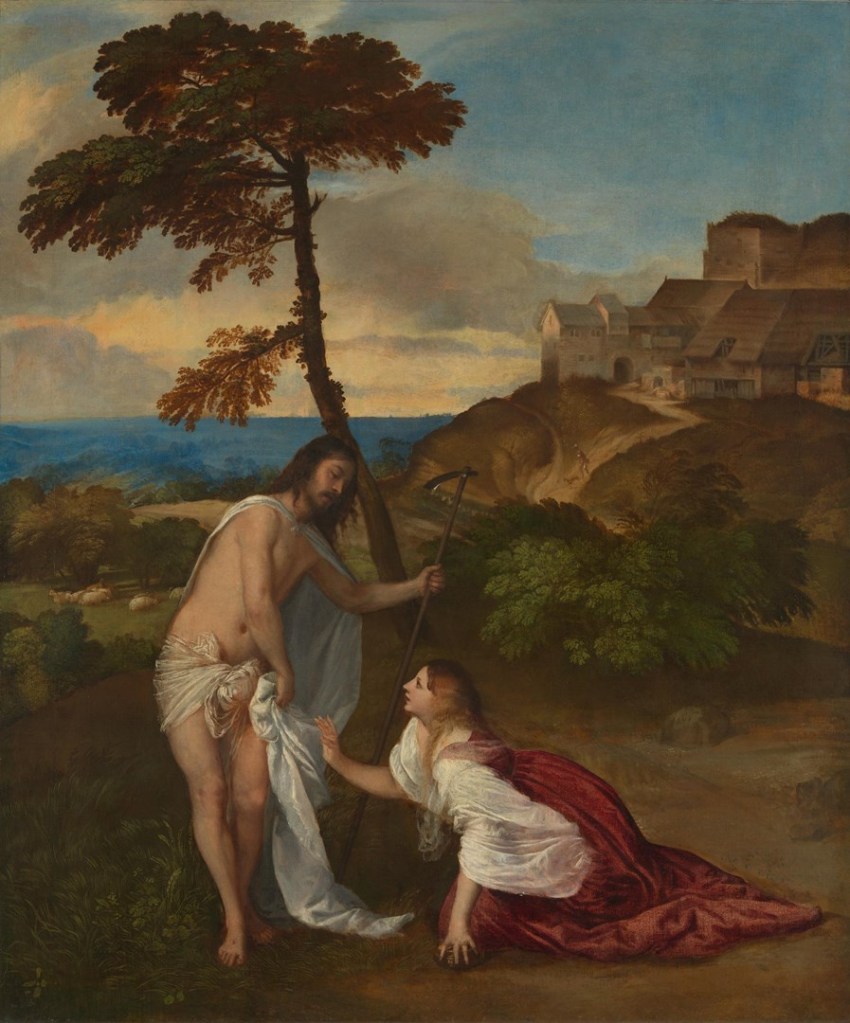
Noli me Tangere by Titian approx 1541 – now held in the National Gallery

Homily

The image above is of Jesus and Mary Magdalene in the garden, when a distraught Mary realises that the one who addresses her is not the gardener but her risen Lord. Its title means “do not hold on to me” – the words Jesus says to her, as her first impulse is to cling to her friend. It is an image of aching loss, desperate longing, glimmering hope and the joyous love which overcomes death.

During WW2 when bombs rained down on London, the collection of art from the National Gallery was removed from the capital to be keep safe in a Welsh slate mine. But in 1942, the Gallery reopened with just a single “Picture of the Month” on display as a letter to The Times explained: “Because London’s face is scarred and bruised these days, we need more than ever to see beautiful things.” The first picture they chose to display was this one.

Almost 80 years later, in the midst of another national crisis, we too live in a world filled with loss and longing, hope and love. It is not easy to shout our Alleluias when we are scared and confused. Don’t feel guilty if today isn’t a straightforwardly celebratory as it has been in the past – it may be a sign that you are closer to Easter than you think. Those first disciples felt fear and confusion alongside their hope and joy too.

Easter erupted into broken lives, among broken people in a broken country. It did not solve every problem, restore every loss, heal every hurt and right every wrong. But it is a sign and a promise that all these things are held by the God who will, one day, restore all that is lost, heal all that has been hurt and right all that is wrong. This is true. This we can cling to.

The writer of Hebrews says “faith is being sure of what we hope for. It is being sure of what we do not see.” It is in faith we shout our Alleluias. Not in denial of the pain and grief that surrounds us, but because we know that pain and grief are not the end of the story. In Easter, we see the desolation and despair of Good Friday overcome by the life and love of God, and know that all we ever experience is held within that story of hope.

A couple of weeks ago, there was phone video of footage of Brazil in lockdown and an entire city block singing from their balconies. The song they sang was an old Gospel song I used to sing with my grandmother. It is a bit cheesy and oversimple, but its words seem more pertinent than ever to me this Easter and I share them with you now:

And so, because Jesus lives, let us in faith and hope proclaim this truth:

Alleluia! Christ is risen!
He is risen indeed! Alleluia!

Intercessions

In joy and hope we pray.
We pray to the Father.
Hear our prayer.

That our risen Saviour may fill us with the joy of his
glorious and life-giving resurrection,
and in these days of uncertainty and worry
help us to be people of hope,
we pray to the Father.
Hear our prayer.

That isolated and persecuted churches
and those Christians who must isolate during this crisis
may find fresh strength in the good news of Easter
we pray to the Father.
Hear our prayer.

That God may provide for those who lack food,
work, or shelter
we pray to the Father.
Hear our prayer.

That by his power war and famine
may cease through all the world,
and that those fleeing conflict
will be protected and provided for
we pray to the Father.
Hear our prayer.

That he may reveal the light of his presence to the sick,
the weak and the dying,
to comfort and strengthen them,
sustain and protect all those who care for the ill,
and daw near to those who grieve
we pray to the Father.
Hear our prayer.

That he may send the fire of the Holy Spirit upon
his people,
so that we may bear faithful witness to his resurrection,
we pray to the Father.
Hear our prayer.

Merciful Father,
accept these prayers
for the sake of your Son,
our Saviour,
Jesus Christ.
Amen

Maundy Thursday Reflections…

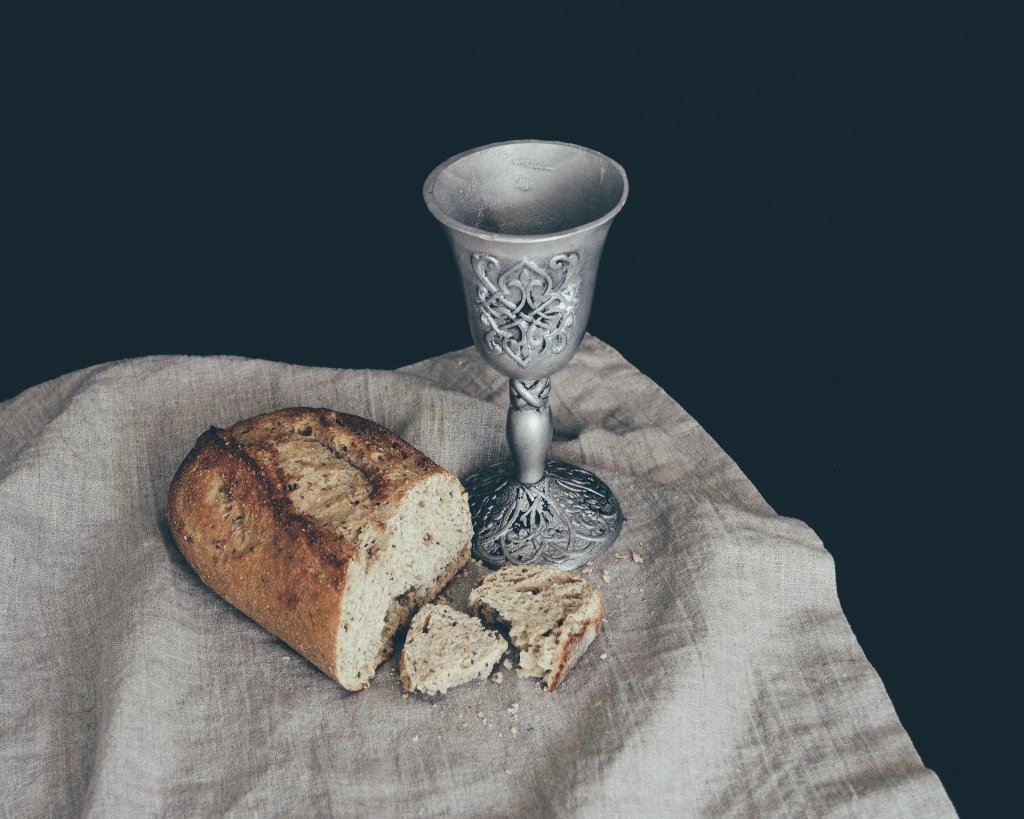
(Image by hudsoncrafted from Pixabay)

For those unable to join our Maundy Thursday Virtual Agape Meal, you might find these readings and reflections helpful to read at home…

Bible Reading: John 15:9-17 (NLT)

“I have loved you even as the Father has loved me. Remain in my love. 10 When you obey my commandments, you remain in my love, just as I obey my Father’s commandments and remain in his love. 11 I have told you these things so that you will be filled with my joy. Yes, your joy will overflow! 12 This is my commandment: Love each other in the same way I have loved you. 13 There is no greater love than to lay down one’s life for one’s friends. 14 You are my friends if you do what I command. 15 I no longer call you slaves, because a master doesn’t confide in his slaves. Now you are my friends, since I have told you everything the Father told me. 16 You didn’t choose me. I chose you. I appointed you to go and produce lasting fruit, so that the Father will give you whatever you ask for, using my name. 17 This is my command: Love each other.

Reflection 1: Love One Another as I Have Love You

Love one another as I have loved you.

That’s what he said.

But what did it mean?  What did it mean to love as he did?

He was such a mixture of things, our friend, our leader…our Messiah?

He would dandy a toddler on his knee one moment and face down a religious leader the next.  Tenderness followed by terrifying certitude.  Who was he, this man?

It wasn’t much better if you were his friend.  One minute he would be in the boat, hauling the ropes of the net, taking in the sail, laughing, eating, chatting…  And then these moments of bewildering otherness, where the wind and waves obeyed him, and his authority shone from him like fire.

Love seems such a gentle word, and yes, he could be gentle.  To the bruised and broken, his look, his words, his touch held them so kindly – they dared believe that new life was possible.

But as he tipped over tables of coins and doves, was that love too?  Love for God and for all God’s children?  Love which abhorred the barriers that kept them apart?  Love which revolted at injustice and exploitation?

Maybe, maybe it was.  Love can make us fierce after all.

I suppose what I noticed about the love Jesus had, was that it made him give everything, absolutely EVERYTHING.  He turned up completely, with all that he had and was, and offered it to us and to his Father. 

The thing was…that night…we had no idea how much more he would give.

Bible Reading: John 13:1-17 (NLT)

Before the Passover celebration, Jesus knew that his hour had come to leave this world and return to his Father. He had loved his disciples during his ministry on earth, and now he loved them to the very end. It was time for supper, and the devil had already prompted Judas, son of Simon Iscariot, to betray Jesus. Jesus knew that the Father had given him authority over everything and that he had come from God and would return to God. So he got up from the table, took off his robe, wrapped a towel around his waist, and poured water into a basin. Then he began to wash the disciples’ feet, drying them with the towel he had around him.

When Jesus came to Simon Peter, Peter said to him, “Lord, are you going to wash my feet?”

Jesus replied, “You don’t understand now what I am doing, but someday you will.”

“No,” Peter protested, “you will never ever wash my feet!”

Jesus replied, “Unless I wash you, you won’t belong to me.”

Simon Peter exclaimed, “Then wash my hands and head as well, Lord, not just my feet!”

10 Jesus replied, “A person who has bathed all over does not need to wash, except for the feet, to be entirely clean. And you disciples are clean, but not all of you.” 11 For Jesus knew who would betray him. That is what he meant when he said, “Not all of you are clean.”

12 After washing their feet, he put on his robe again and sat down and asked, “Do you understand what I was doing? 13 You call me ‘Teacher’ and ‘Lord,’ and you are right, because that’s what I am. 14 And since I, your Lord and Teacher, have washed your feet, you ought to wash each other’s feet. 15 I have given you an example to follow. Do as I have done to you. 16 I tell you the truth, slaves are not greater than their master. Nor is the messenger more important than the one who sends the message. 17 Now that you know these things, God will bless you for doing them.

Reflection: Feet

Feet.

Smelly, dirty feet.

We had been out and about all day preparing for the Passover.  The city was heaving with people and animals as Jews gathered for the great festival.  The roads and the alleys were thick with dust and debris. Our feet were filthy.  Not that we noticed much, in the end, as our noses were accustomed to the stink.

Gathered in the upper room, body odours were lost in the aroma of roasting lamb.  We anticipated a tasty meal.  We anticipated too that Jesus’ ministry was about to come to its climax, and the atmosphere was electric.  Would it be soon?  Would we see him reign as the rightful and righteous King of Israel? Our engaging yet enigmatic friend – would he finally reveal the glory that we had seen in glimpses and snatches over the past three years?

We could barely breathe.

And then, he takes off his outer robe, takes a towel and bowl from the servant and kneels down at my feet.  In the chaos and chatter of the party, he radiates the stillness of one who knows exactly what he is doing.  He is the only one.  As people see what has happened, the talk subsides to confused whispers, embarrassed looks, silent shock…

And slowly he washes my feet, tenderly, like my Mum used to do. Then he pats them dry with the rough cloth.  My grimy skin is now pink and new.  I look at him in puzzlement, my face asking the question I have no words to speak.  He smiles briefly and moves on to my neighbour.

When he finished washing our feet, even those of protesting Peter, he put on his robe and sat back at the table.  And we began to see that glory might not look quite as we had imagined it.  Our friend was a very different sort of King.  Little did we know this was only the beginning…

Bible Reading: Mark 14:22-26 (NLT)

22 As they were eating, Jesus took some bread and blessed it. Then he broke it in pieces and gave it to the disciples, saying, “Take it, for this is my body.”

23 And he took a cup of wine and gave thanks to God for it. He gave it to them, and they all drank from it. 24 And he said to them, “This is my blood, which confirms the covenant between God and his people. It is poured out as a sacrifice for many. 25 I tell you the truth, I will not drink wine again until the day I drink it new in the Kingdom of God.”

26 Then they sang a hymn and went out to the Mount of Olives.

Reflection: The Last Supper

We were well used to puzzling sayings.

Three years of travelling with Jesus, and we had heard his stories many times. And we still didn’t understand them all.

It is easier for a camel to go through the eye of a needle than a rich person to enter the Kingdom…

A Samaritan – dreaded enemy – can be our righteous neighbour…

We need not just to welcome little children but be like them…

No, we had a long way to go before we understood, but as we walked through the dusty lanes of Palestine, we pondered his words. They became part of our soul, these puzzling sayings, shaping our thinking, guiding our hearts, skewing our comfortable perspective, even as we wonder what they mean.

So, in the middle of the meal when he picks up a flatbread and tears it in two: “this is my body given for you…” Well, we are used to him by now, and take the bread he offers and store his words in our heart.

Later he passes round the cup “this is my blood…remember me!” As if we could forget.

It was only afterwards it all made sense. That night he had washed our feet like a common slave. The next morning he didn’t even have that dignity. That night he gave us bread and wine as the next day his body and blood were given for all.

He was trying to tell us I know…I know…This is WHO I AM!

But that night, we still didn’t understand. And when it began we panicked and ran…

Bible Reading: Mark 14:32-50 (NLT)

32 They went to the olive grove called Gethsemane, and Jesus said, “Sit here while I go and pray.” 33 He took Peter, James, and John with him, and he became deeply troubled and distressed. 34 He told them, “My soul is crushed with grief to the point of death. Stay here and keep watch with me.”

35 He went on a little farther and fell to the ground. He prayed that, if it were possible, the awful hour awaiting him might pass him by. 36 “Abba, Father,” he cried out, “everything is possible for you. Please take this cup of suffering away from me. Yet I want your will to be done, not mine.”

37 Then he returned and found the disciples asleep. He said to Peter, “Simon, are you asleep? Couldn’t you watch with me even one hour? 38 Keep watch and pray, so that you will not give in to temptation. For the spirit is willing, but the body is weak.”

39 Then Jesus left them again and prayed the same prayer as before. 40 When he returned to them again, he found them sleeping, for they couldn’t keep their eyes open. And they didn’t know what to say.

41 When he returned to them the third time, he said, “Go ahead and sleep. Have your rest. But no—the time has come. The Son of Man is betrayed into the hands of sinners. 42 Up, let’s be going. Look, my betrayer is here!”

43 And immediately, even as Jesus said this, Judas, one of the twelve disciples, arrived with a crowd of men armed with swords and clubs. They had been sent by the leading priests, the teachers of religious law, and the elders. 44 The traitor, Judas, had given them a prearranged signal: “You will know which one to arrest when I greet him with a kiss. Then you can take him away under guard.” 45 As soon as they arrived, Judas walked up to Jesus. “Rabbi!” he exclaimed, and gave him the kiss.

46 Then the others grabbed Jesus and arrested him. 47 But one of the men with Jesus pulled out his sword and struck the high priest’s slave, slashing off his ear.

48 Jesus asked them, “Am I some dangerous revolutionary, that you come with swords and clubs to arrest me? 49 Why didn’t you arrest me in the Temple? I was there among you teaching every day. But these things are happening to fulfill what the Scriptures say about me.”

50 Then all his disciples deserted him and ran away. 

Reflection: Gethsemane

And so I ran…

I ran until my chest was fire and I could barely see for sweat. My legs screamed protest as I sprinted desperately through the dark Jerusalem streets. A glimpse of the Roman guard sent me tumbling behind a barrel, hidden in the shadows until the threat was passed. And then finally, I found the door, tapping it as loud as I dared, hissing urgent pleas for entry.

Hurry, hurry, hurry…

A servant girl opened the door and I bundled past her into the courtyard where the women were tidying away the remains of our earlier festivities. One look at my face and they turned white with fear. Words were needless. They knew all we had dreaded, but never believed would happen, had come to pass. His mother sank to the ground in agony, her sisters holding her as if to prevent her from dissolving with grief. Her whispered prayers were all that broke our silence.

Over the coming hours, the men returned – alone, in pairs, wide eyed with terror and broken with shame. “They took him.” “We left him.” “We ran…”

We sat in a ragged circle and waited through the sleepless night. We who had dosed in the garden, drowsy through food and wine, found all thought of sleep had left us in those hopeless, helpless hours.

Finally, as dawn broke, Peter arrived back. He was barely recognizable as Jesus’ right hand man. A little boy lost, he walked over to Mary of Magdala and, in a voice of wondering disbelief, he blurted: “They have him. They will try him and they want to kill him.” Then he crumpled and cried, “And I said I didn’t even know him.”

And then we all wept…

Stations of the Cross – Part 3

Stations of the Cross

Stations of the Cross is a way of praying with Jesus as we remember all he suffered for us. It is used by many Christians during Lent, Holy Week and especially on Good Friday.

This version follows the Bible readings which describe Jesus’ final hours.  For each station there is an image by Ally Barrett, a Bible reading and a question.

The questions are inspired by the American spiritual song “Were You There When They Crucified My Lord?”  The question is an invitation to imagine yourself in the story.  What would you see, hear, smell?  How would you feel?  What would you be thinking?

The final line is a suggested focus for prayer.

You may want to use the spaces in the booklet to doodle or write your own prayers.

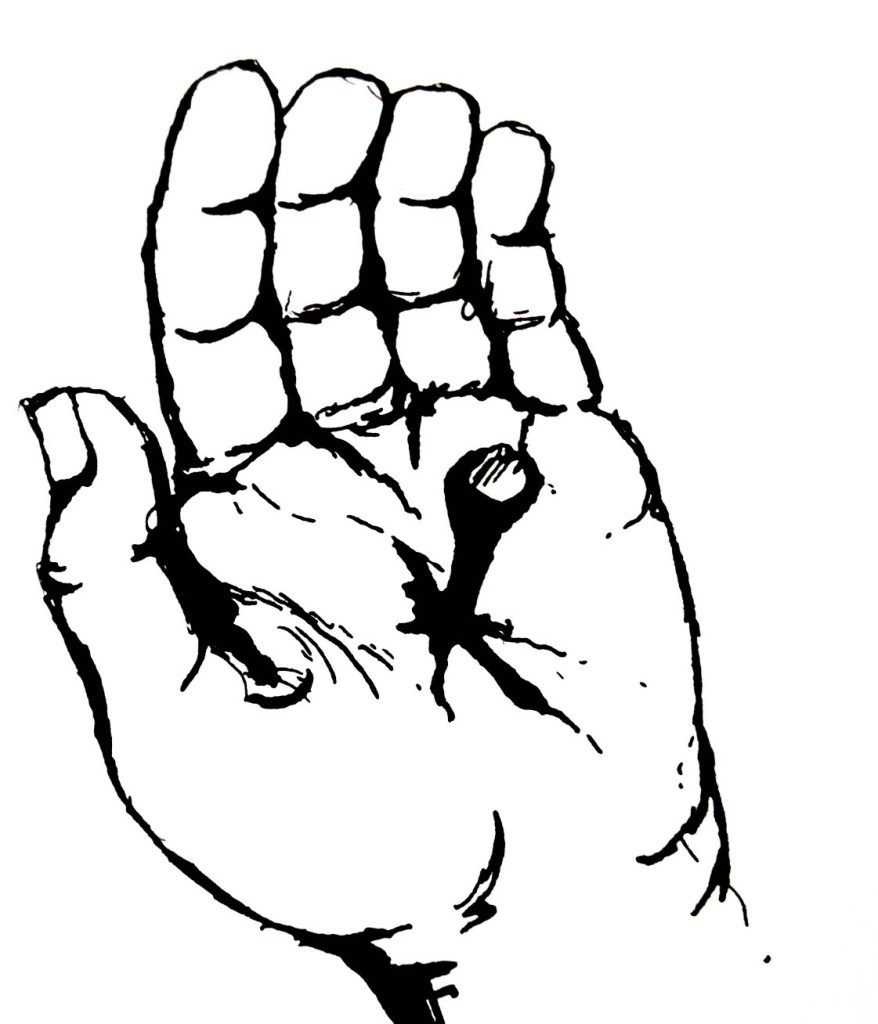
Artworks kindly shared by Rev Dr Ally Barrett (https://reverendally.org/clipart/) The Bible readings are taken from the New Living Translation copyright © 1996, 2004, 2015 by Tyndale House Foundation.  The questions and prayer prompts were written by Susan West. The Opening and Closing Prayers are from Common Worship Times and Seasons © The Archbishops Council 2000

Opening Prayer

Almighty and everlasting God,
who in your tender love towards the human race
sent your Son our Saviour Jesus Christ
to take upon him our flesh
and to suffer death upon the cross:
grant that we may follow the example of his patience and humility,
and also be made partakers of his resurrection;
through Jesus Christ your Son our Lord,
who is alive and reigns with you,
in the unity of the Holy Spirit,
one God, now and for ever.
All   Amen.

10 Jesus is crucified – Luke 23: 32-34

32 Two others, both criminals, were led out to be executed with him. 33 When they came to a place called The Skull, they nailed him to the cross. And the criminals were also crucified—one on his right and one on his left.

34 Jesus said, “Father, forgive them, for they don’t know what they are doing.” And the soldiers gambled for his clothes by throwing dice.

Were you there when they nailed him to the tree?
Remember all compelled to act under orders.

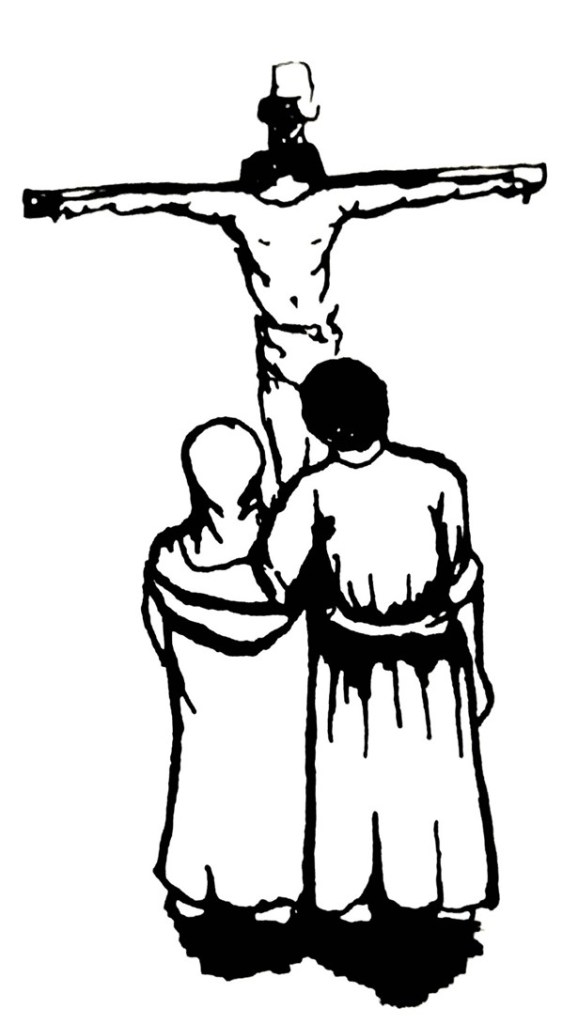
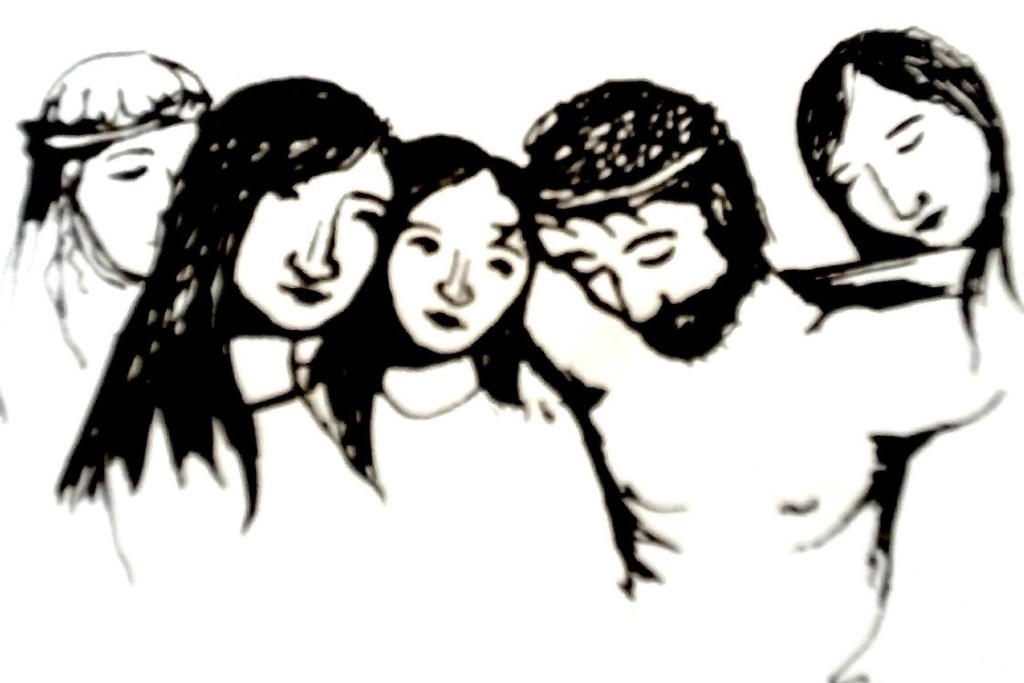
11 Jesus speaks to his mother – John 19: 25-27

25 Standing near the cross were Jesus’ mother, and his mother’s sister, Mary (the wife of Clopas), and Mary Magdalene. 26 When Jesus saw his mother standing there beside the disciple he loved, he said to her, “Dear woman, here is your son.” 27 And he said to this disciple, “Here is your mother.” And from then on this disciple took her into his home.

Were you there when Mary’s eyes filled with tears?
Remember all who feel helpless.

12 Jesus dies – Luke 23: 44-46

44 By this time it was about noon, and darkness fell across the whole land until three o’clock. 45 The light from the sun was gone. And suddenly, the curtain in the sanctuary of the Temple was torn down the middle. 46 Then Jesus shouted, “Father, I entrust my spirit into your hands!” And with those words he breathed his last.

Were you there when the sun refused to shine?
Remember all living in the darkness of despair.

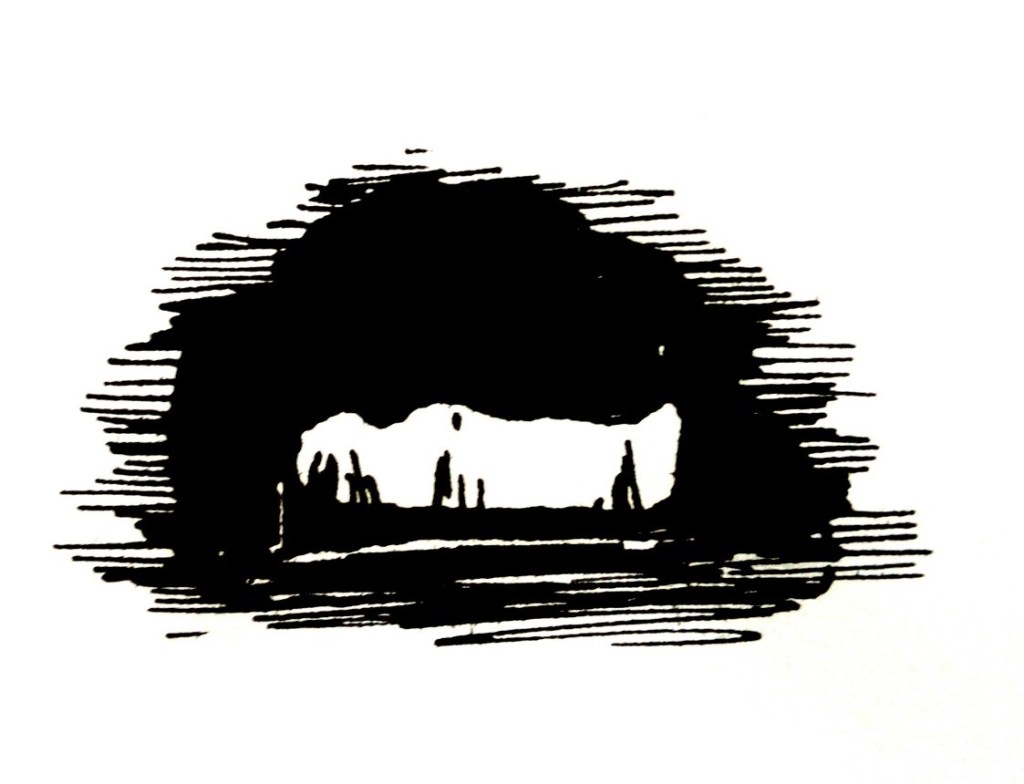
13 Jesus placed in the tomb – Matthew 27: 57-60

57 As evening approached, Joseph, a rich man from Arimathea who had become a follower of Jesus, 58 went to Pilate and asked for Jesus’ body. And Pilate issued an order to release it to him. 59 Joseph took the body and wrapped it in a long sheet of clean linen cloth. 60 He placed it in his own new tomb, which had been carved out of the rock. Then he rolled a great stone across the entrance and left.

Were you there when they rolled the stone in place?
Remember all who see no way forward
.

Holy Saturday…

Do not rush too quickly to the final station. Wait as Jesus’ friends waited…

14 Easter Day – Matthew 28: 5-7

Then the angel spoke to the women. “Don’t be afraid!” he said. “I know you are looking for Jesus, who was crucified. He isn’t here! He is risen from the dead, just as he said would happen. Come, see where his body was lying. And now, go quickly and tell his disciples that he has risen from the dead, and he is going ahead of you to Galilee. You will see him there. Remember what I have told you.”

Were you there when he rose up from the dead?
Rejoice!

Closing Prayers

Let us pray for the coming of God’s kingdom
in the words our Saviour taught us.

The Lord’s Prayer is said.

Most merciful God,
who by the death and resurrection of your Son Jesus Christ
delivered and saved the world:
grant that by faith in him who suffered on the cross
we may triumph in the power of his victory;
through Jesus Christ your Son our Lord,
who is alive and reigns with you,
in the unity of the Holy Spirit,
one God, now and for ever.
Amen.

You are worthy, O Lamb, for you were slain,
and by your blood you ransomed for God
saints from every tribe and language and nation;
you have made them to be a kingdom and priests
serving our God.
We adore you, O Christ, and we bless you,
because by your holy cross you have redeemed the world.

To him who loves us
and has freed us from our sins by his blood,
and made us a kingdom of priests
to stand and serve before our God;
to him who sits upon the throne and to the Lamb
be praise and honour, glory and might,
for ever and ever. Amen.

Stations of the Cross – Part 2

Stations of the Cross

Stations of the Cross is a way of praying with Jesus as we remember all he suffered for us. It is used by many Christians during Lent, Holy Week and especially on Good Friday.

This version follows the Bible readings which describe Jesus’ final hours.  For each station there is an image by Ally Barrett, a Bible reading and a question.

The questions are inspired by the American spiritual song “Were You There When They Crucified My Lord?”  The question is an invitation to imagine yourself in the story.  What would you see, hear, smell?  How would you feel?  What would you be thinking?

The final line is a suggested focus for prayer.

You may want to use the spaces in the booklet to doodle or write your own prayers.

Artworks kindly shared by Rev Dr Ally Barrett (https://reverendally.org/clipart/) The Bible readings are taken from the New Living Translation copyright © 1996, 2004, 2015 by Tyndale House Foundation.  The questions and prayer prompts were written by Susan West. The Opening and Closing Prayers are from Common Worship Times and Seasons © The Archbishops Council 2000

Opening Prayer

Almighty and everlasting God,
who in your tender love towards the human race
sent your Son our Saviour Jesus Christ
to take upon him our flesh
and to suffer death upon the cross:
grant that we may follow the example of his patience and humility,
and also be made partakers of his resurrection;
through Jesus Christ your Son our Lord,
who is alive and reigns with you,
in the unity of the Holy Spirit,
one God, now and for ever.All   Amen.

6 The scourging and crowning with thorns – John 19: 1-3

Then Pilate had Jesus flogged with a lead-tipped whip. The soldiers wove a crown of thorns and put it on his head, and they put a purple robe on him. “Hail! King of the Jews!” they mocked, as they slapped him across the face.

Were you there when the soldiers held the whip?
Remember all who suffer cruelty.

7 Jesus bears his cross – John 19: 6, 15-17

When they saw him, the leading priests and Temple guards began shouting, “Crucify him! Crucify him!”

“Take him yourselves and crucify him,” Pilate said. “I find him not guilty.”

15 “Away with him,” they yelled. “Away with him! Crucify him!”

“What? Crucify your king?” Pilate asked.

“We have no king but Caesar,” the leading priests shouted back.

16 Then Pilate turned Jesus over to them to be crucified.

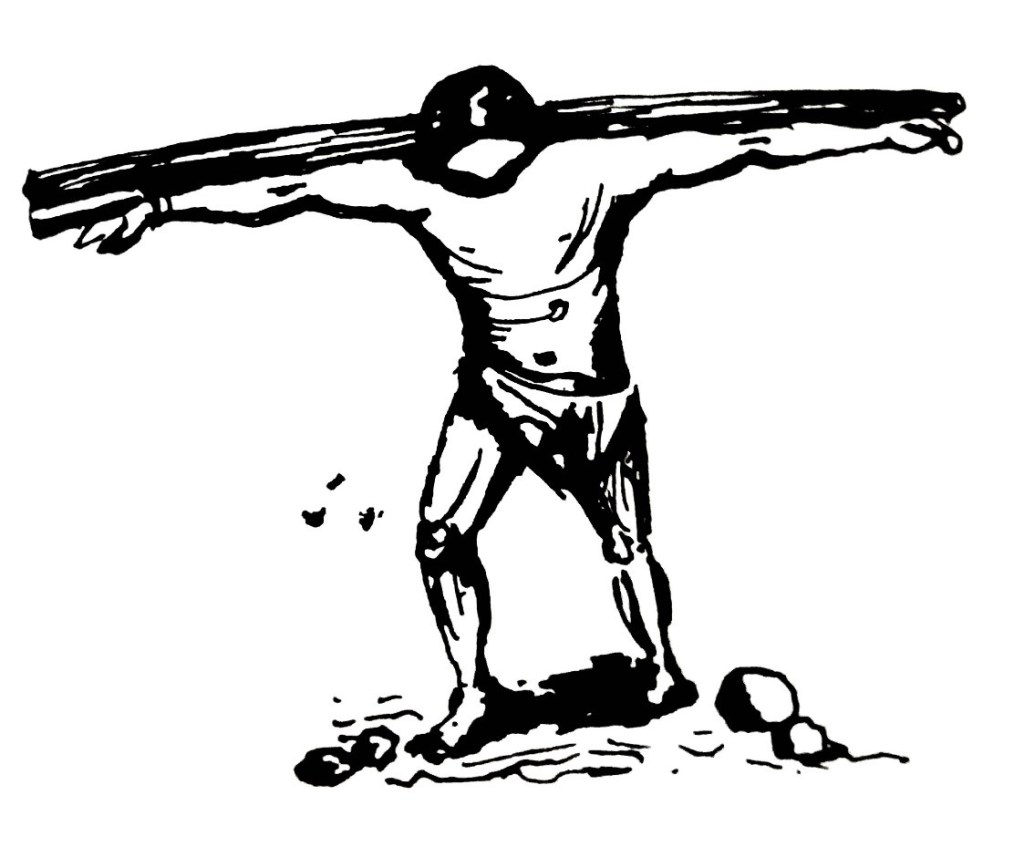
So they took Jesus away. 17 Carrying the cross by himself, he went to the place called Place of the Skull (in Hebrew, Golgotha).

Were you there when they laid the cross on him?
Remember all who carry heavy burdens in life.

8 Simon helps Jesus – Mark 15: 21

21 A passer-by named Simon, who was from Cyrene, was coming in from the countryside just then, and the soldiers forced him to carry Jesus’ cross. (Simon was the father of Alexander and Rufus.)

Were you there when Simon helped the Lord?
Remember all who come to the aid of others.

9 Jesus meets the women – Luke 23: 27-31

27 A large crowd trailed behind, including many grief-stricken women. 28 But Jesus turned and said to them, “Daughters of Jerusalem, don’t weep for me, but weep for yourselves and for your children. 29 For the days are coming when they will say, ‘Fortunate indeed are the women who are childless, the wombs that have not borne a child and the breasts that have never nursed.’ 30 People will beg the mountains, ‘Fall on us,’ and plead with the hills, ‘Bury us.’ 31 For if these things are done when the tree is green, what will happen when it is dry?[

Were you there when the women wept for him?
Remember all who grieve for loved ones.

Stations of the Cross – Part 1

Stations of the Cross is a way of praying with Jesus as we remember all he suffered for us. It is used by many Christians during Lent, Holy Week and especially on Good Friday.

This version follows the Bible readings which describe Jesus’ final hours.  For each station there is an image by Ally Barrett, a Bible reading and a question.

The questions are inspired by the American spiritual song “Were You There When They Crucified My Lord?”  The question is an invitation to imagine yourself in the story.  What would you see, hear, smell?  How would you feel?  What would you be thinking?

The final line is a suggested focus for prayer.

You may want to use the spaces in the booklet to doodle or write your own prayers.

Artworks kindly shared by Rev Dr Ally Barrett (https://reverendally.org/clipart/) The Bible readings are taken from the New Living Translation copyright © 1996, 2004, 2015 by Tyndale House Foundation.  The questions and prayer prompts were written by Susan West. The Opening and Closing Prayers are from Common Worship Times and Seasons © The Archbishops Council 2000

Opening Prayer

Almighty and everlasting God,
who in your tender love towards the human race
sent your Son our Saviour Jesus Christ
to take upon him our flesh
and to suffer death upon the cross:
grant that we may follow the example of his patience and humility,
and also be made partakers of his resurrection;
through Jesus Christ your Son our Lord,
who is alive and reigns with you,
in the unity of the Holy Spirit,
one God, now and for ever.
All   Amen.


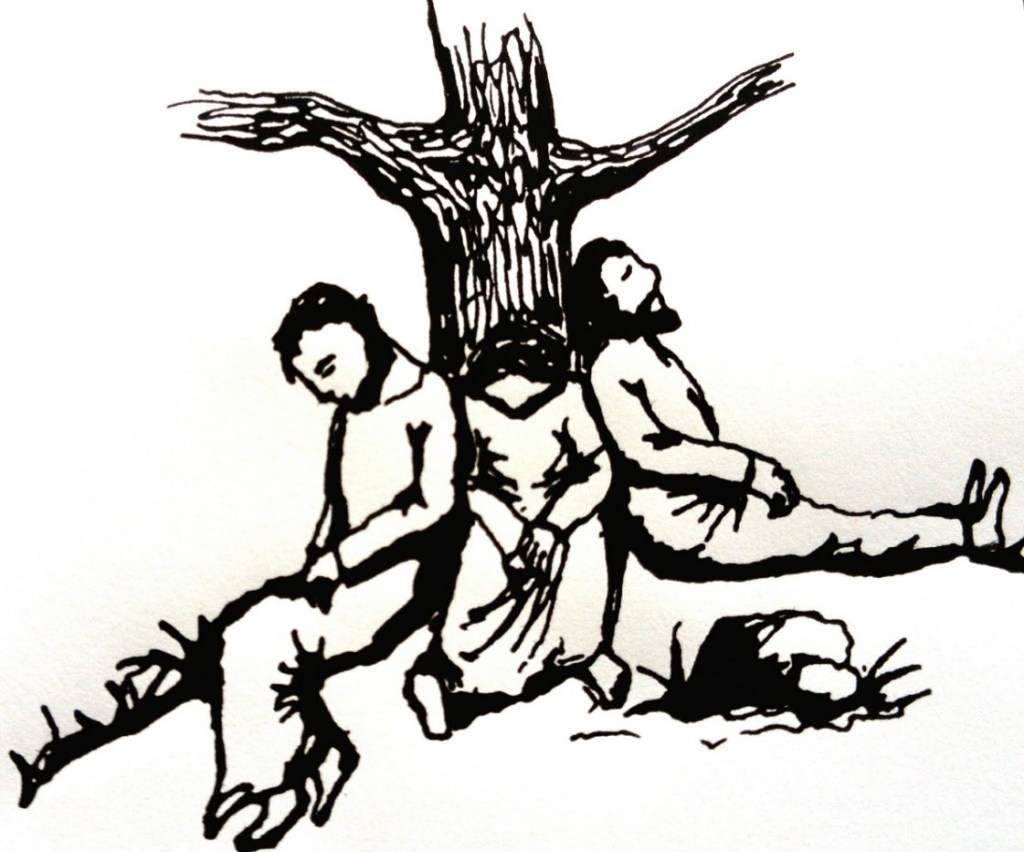
1 Jesus in the garden – Matthew 26: 36-41

36 Then Jesus went with them to the olive grove called Gethsemane, and he said, “Sit here while I go over there to pray.” 37 He took Peter and Zebedee’s two sons, James and John, and he became anguished and distressed. 38 He told them, “My soul is crushed with grief to the point of death. Stay here and keep watch with me.”

39 He went on a little farther and bowed with his face to the ground, praying, “My Father! If it is possible, let this cup of suffering be taken away from me. Yet I want your will to be done, not mine.”

40 Then he returned to the disciples and found them asleep. He said to Peter, “Couldn’t you watch with me even one hour? 41 Keep watch and pray, so that you will not give in to temptation. For the spirit is willing, but the body is weak!”

Were you there when Jesus fell upon his knees?
Remember all who call out in anguish.


2 Betrayal and arrest – Mark 14: 43-46

43 And immediately, even as Jesus said this, Judas, one of the twelve disciples, arrived with a crowd of men armed with swords and clubs. They had been sent by the leading priests, the teachers of religious law, and the elders. 44 The traitor, Judas, had given them a prearranged signal: “You will know which one to arrest when I greet him with a kiss. Then you can take him away under guard.” 45 As soon as they arrived, Judas walked up to Jesus. “Rabbi!” he exclaimed and gave him the kiss.

46 Then the others grabbed Jesus and arrested him.

Were you there when a kiss betrayed our Lord?
Remember all who are damaged by lies.


3 Trial by the Sanhedrin – Luke 22: 66-71

66 At daybreak all the elders of the people assembled, including the leading priests and the teachers of religious law. Jesus was led before this high council, 67 and they said, “Tell us, are you the Messiah?”

But he replied, “If I tell you, you won’t believe me. 68 And if I ask you a question, you won’t answer. 69 But from now on the Son of Man will be seated in the place of power at God’s right hand.”

70 They all shouted, “So, are you claiming to be the Son of God?”

And he replied, “You say that I am.”

71 “Why do we need other witnesses?” they said. “We ourselves heard him say it.”

Were you there when Jesus was accused?
Remember all who face unjust trial.


4 Denial by Peter – Matthew 26: 69-75

69 Meanwhile, Peter was sitting outside in the courtyard. A servant girl came over and said to him, “You were one of those with Jesus the Galilean.”

70 But Peter denied it in front of everyone. “I don’t know what you’re talking about,” he said.

71 Later, out by the gate, another servant girl noticed him and said to those standing around, “This man was with Jesus of Nazareth.”

72 Again Peter denied it, this time with an oath. “I don’t even know the man,” he said.

73 A little later some of the other bystanders came over to Peter and said, “You must be one of them; we can tell by your Galilean accent.”

74 Peter swore, “A curse on me if I’m lying—I don’t know the man!” And immediately the rooster crowed.

75 Suddenly, Jesus’ words flashed through Peter’s mind: “Before the rooster crows, you will deny three times that you even know me.” And he went away, weeping bitterly.

Were you there when the cockerel crowed three times? Remember all who fail through fear.

5 Judgement by Pilate – Mark 15: 1-15

Very early in the morning the leading priests, the elders, and the teachers of religious law—the entire high council—met to discuss their next step. They bound Jesus, led him away, and took him to Pilate, the Roman governor. Pilate asked Jesus, “Are you the king of the Jews?” Jesus replied, “You have said it.”

Then the leading priests kept accusing him of many crimes, and Pilate asked him, “Aren’t you going to answer them? What about all these charges they are bringing against you?” But Jesus said nothing, much to Pilate’s surprise.

Now it was the governor’s custom each year during the Passover celebration to release one prisoner—anyone the people requested. One of the prisoners at that time was Barabbas, a revolutionary who had committed murder in an uprising. The crowd went to Pilate and asked him to release a prisoner as usual.

“Would you like me to release to you this ‘King of the Jews’?” Pilate asked. 10 (For he realized by now that the leading priests had arrested Jesus out of envy.) 11 But at this point the leading priests stirred up the crowd to demand the release of Barabbas instead of Jesus. 12 Pilate asked them, “Then what should I do with this man you call the king of the Jews?” 13 They shouted back, “Crucify him!” 14 “Why?” Pilate demanded. “What crime has he committed?” But the mob roared even louder, “Crucify him!”

15 So to pacify the crowd, Pilate released Barabbas to them. He ordered Jesus flogged with a lead-tipped whip, then turned him over to the Roman soldiers to be crucified.

Were you there when Jesus was condemned?
Remember all we fail to stand up for.

Compline (Night Prayer) in Holy Week

An Order for Night Prayer (Compline) in Holy Week

The Lord almighty grant us a quiet night
and a perfect end.
Amen.

Our help is in the name of the Lord
who made heaven and earth.

A period of silence for reflection on the past day may follow.

Most merciful God,
we confess to you,
before the whole company of heaven and one another,
that we have sinned in thought, word and deed
and in what we have failed to do.
Forgive us our sins,
heal us by your Spirit
and raise us to new life in Christ. Amen.

O God, make speed to save us.
O Lord, make haste to help us.

Glory to the Father and to the Son
and to the Holy Spirit;
as it was in the beginning is now
and shall be for ever. Amen.
Alleluia.

Psalm 139

1O Lord, you have searched me out and known me; 
you know my sitting down and my rising up;
you discern my thoughts from afar.

2You mark out my journeys and my resting place 
and are acquainted with all my ways.

3For there is not a word on my tongue, 
but you, O Lord, know it altogether.

4You encompass me behind and before
and lay your hand upon me.

5Such knowledge is too wonderful for me, 
so high that I cannot attain it. 

6Where can I go then from your spirit? 
Or where can I flee from your presence?

7If I climb up to heaven, you are there; 
if I make the grave my bed, you are there also.

8If I take the wings of the morning 
and dwell in the uttermost parts of the sea,

9Even there your hand shall lead me, 
your right hand hold me fast.

10If I say, ‘Surely the darkness will cover me 
and the light around me turn to night,’

11Even darkness is no darkness with you;
the night is as clear as the day; 
darkness and light to you are both alike. 

12For you yourself created my inmost parts; 
you knit me together in my mother’s womb.

13I thank you, for I am fearfully and wonderfully made; 
marvellous are your works, my soul knows well.

14My frame was not hidden from you, 
when I was made in secret
and woven in the depths of the earth.

15Your eyes beheld my form, as yet unfinished; 
already in your book were all my members written,

16As day by day they were fashioned 
when as yet there was none of them.

17How deep are your counsels to me, O God! 
How great is the sum of them!

18If I count them, they are more in number than the sand, 
and at the end, I am still in your presence. 

Glory to the Father and to the Son
and to the Holy Spirit;
as it was in the beginning is now
and shall be for ever. Amen.

Scripture Reading and Reflection

Responsory

Into your hands, O Lord, I commend my spirit.
For you have redeemed me, Lord God of truth.
I commend my spirit.
Glory to the Father and to the Son
and to the Holy Spirit.
Into your hands, O Lord, I commend my spirit.

Keep me as the apple of your eye.
Hide me under the shadow of your wings.

Gospel Canticle (Nunc Dimittis)

Christ himself bore our sins in his body on the tree,
that we might die to sin and live to righteousness.

Now, Lord, you let your servant go in peace: 
your word has been fulfilled.

My own eyes have seen the salvation 
which you have prepared in the sight of every people;

A light to reveal you to the nations 
and the glory of your people Israel.

Luke 2.29-32

Glory to the Father and to the Son
and to the Holy Spirit;
as it was in the beginning is now
and shall be for ever. Amen.

Christ himself bore our sins in his body on the tree,
that we might die to sin and live to righteousness.

Intercessions

Collect

Silence may be kept.

Almighty God,
as we stand at the foot of the cross of your Son,
help us to see and know your love for us,
so that in humility, love and joy
we may place at his feet
all that we have and all that we are;
through Jesus Christ our Saviour.
Amen.

Keep watch, dear Lord,
with those who work, or watch, or weep this night,
and give your angels charge over those who sleep.
Tend the sick, Lord Christ; give rest to the weary, bless the dying,
soothe the suffering, pity the afflicted, shield the joyous;
and all for your love’s sake. 
Amen.

The Lord’s Prayer

In peace we will lie down and sleep;
for you alone, Lord, make us dwell in safety.

Abide with us, Lord Jesus,
for the night is at hand and the day is now past.

As the night watch looks for the morning,
so do we look for you, O Christ.

May God bless us,
that in us may be found love and humility,
obedience and thanksgiving,
discipline, gentleness and peace.

© The Archbishops’ Council of the Church of England, 2000-2005
Official Common Worship apps, books and eBooks are available from Church House Publishing.

Readings, Hymns, Sermon and Prayers for Palm Sunday, 5th April 2020

If you have a Palm Cross – one you have kept or one you have made, why not hold it up, read these words and say the Palm Cross prayer:

During Lent we have been preparing by works of love and self-sacrifice for the celebration of our Lord’s death and resurrection. Today we begin this solemn celebration in union with the Church throughout the world. Christ enters his own city to complete his work as our Saviour, to suffer, to die, and to rise again. Let us go with him in faith and love, so that, united with him in his sufferings, we may share his risen life.

The people hold up palms or branches while this prayer is said by the president

God our Saviour,
whose Son Jesus Christ entered Jerusalem as Messiah to suffer
and to die;
let these palms be for us signs of his victory
and grant that we who bear them in his name
may ever hail him as our King,
and follow him in the way that leads to eternal life;
who is alive and reigns with you,
in the unity of the Holy Spirit,
one God, now and for ever.
Amen.

Opening Hymn

Gospel Reading: Matthew 21:1-11

As Jesus and the disciples approached Jerusalem, they came to the town of Bethphage on the Mount of Olives. Jesus sent two of them on ahead. “Go into the village over there,” he said. “As soon as you enter it, you will see a donkey tied there, with its colt beside it. Untie them and bring them to me. If anyone asks what you are doing, just say, ‘The Lord needs them,’ and he will immediately let you take them.”

This took place to fulfill the prophecy that said,

“Tell the people of Jerusalem,
    ‘Look, your King is coming to you.
He is humble, riding on a donkey—
    riding on a donkey’s colt.’”

The two disciples did as Jesus commanded. They brought the donkey and the colt to him and threw their garments over the colt, and he sat on it.

Most of the crowd spread their garments on the road ahead of him, and others cut branches from the trees and spread them on the road. Jesus was in the center of the procession, and the people all around him were shouting,

“Praise God for the Son of David!
    Blessings on the one who comes in the name of the Lord!
    Praise God in highest heaven!”

10 The entire city of Jerusalem was in an uproar as he entered. “Who is this?” they asked.

11 And the crowds replied, “It’s Jesus, the prophet from Nazareth in Galilee.” (NLT)

Sermon – by Rev’d Jo Joyce

Palm Sunday is a funny time isn’t it? There is a such a contrast of emotions from the excitement of the crowds of Jesus’ followers, to the obedience of the folk who collected the donkey and colt for Jesus to ride, to the anger of Jesus in the temple and I guess the bewilderment and eventually anger of the many onlookers, wondering what on earth was going on and who was this bloke anyway?

My guess is that like me you might be feeling a whole mix of emotions this week as we go into a very strange and different sort of Holy Week. Whether its sadness at being along, worry about work or health or those moments of joy at the care and support of the community, finding a new skill or the beauty of the spring sunshine. Its been a bit of a rollercoaster!

Jesus’s followers were very excited at his entry to Jerusalem, and in this triumphal entry he was making a very clear and thought out gesture, but very soon they were quickly disappointed when he didn’t turn out to be the kind of King they were hoping for. It’s so easy isn’t it to try and make God in our own image, to expect that God thinks like us and does things the way we expect.

Tied up in the joy of Palm Sunday is a whole load of hope that maybe Jesus will be the one to solve our problems in the way we want them solved. They hoped for a war with the Romans, the ousting of an occupying force. What they got was a saviour who talked about loving enemies, turning the other cheek and loving our neighbour – nothing about the vengeful uprising they hoped for.

We sometimes hope for a God who will remove all our problems and be the quick and easy solution, in answer to our prayers. It’s always tempting to try and take the easy way out, when of course the way out is often hard and complicated. In the situation we find ourselves in today we all long to wake up tomorrow and find it has all gone away. But it’s not like that, sometimes the solution to difficult things is long and hard, it doesn’t look how we had hoped, and we have to wait slowly for change to come and there to be a new dawn.

The story of Holy Week is that God is there in that waiting, suffering alongside us, and in the waiting, we are changed. By God’s grace we can become kinder, more community minded and learn to love our neighbour – even if we have never met them, just as the disciples and their understanding of who Jesus was also changed radically over that first Holy Week.

The excitement of Palm Sunday was not misplaced, the people were right to become excited as Jesus came to town, it was just that their understanding of the solution to the problem was misplaced. Jesus’s victory didn’t look like a triumphant battle, instead it looked like the cross and resurrection. God’s solution was not just to solve the immediate problems there and then but to bring a reconciliation for all people for all time. Have a blessed and joyful Palm Sunday as you prepare to go into the waiting of Holy Week.

Intercessions

Living God,
In our hour of need we turn again to you, for we have nowhere else to turn.
We put our faith in you, because you have proved your faithfulness time and again.
We reaffirm our love for you because you have never let us go.
We thank you that you are not distant from us.
but have drawn near, in your Son, our Saviour, Jesus Christ.
He has shared our life, tasted our death and defeated it;
He understands our worries and our fears.
Help us to respond as your children now.

We pray for this pandemic spreading across our world,
remembering all who have lost loved ones,
and praying for those seriously ill at this time.
We uphold the National Health Service,
as it responds to this added pressure on its already overstretched services.
We pray for doctors and nurses and all in the caring professions,
who work to help and support people as best they can.
We remember those working behind the scenes,
testing samples, confirming results, giving information to patients.
We uphold others trying to understand this virus better,
working to create an effective remedy.

We pray for our Governments in Westminster, Holyrood, Cardiff and Belfast,
as they work with the best medical advice.
to guide us on how we should respond,
and what action we should take.
We pray that these guidelines might be taken seriously,
and that all would put them into action.
May this crisis bring out the best in us, not the worst.
Help us to live by faith and not by fear;
to build bridges not barriers,
and to resist all who would speak ill of any other group.
May we not forget our responsibility to one another,
not least to the vulnerable and voiceless in our communities.

Help us to find ways of keeping in touch and offering reassurance
to those with underlying health issues;
for any who feel particularly vulnerable
or in danger at present.

As the virus spreads,
we pray for the disruption it causes to normal life,
bringing new fears and anxieties:
We pray for those who have been laid off as their work disappears;
for financial hardship for individuals and businesses;
for the impact on the economy and pensions, when austerity has already left its mark.
We pray for those whose trips, both for business and pleasure, have been cancelled;
and others where events, long anticipated and planned for, have been postponed;
for those making contingency planning for home based work or child care or exams.
May our inconvenience not blind us to others’ loss.

We remember those
who cannot visit loved ones in locked-down care homes;
for the elderly whose social contacts have been severely curtailed;
help us to find creative ways of keeping in touch,
of assuring them they are not forgotten or ignored.

May congregations find new ways of living though this time.
May we not forget our faith, but draw strength from it.
So may our worship be heartfelt,
our fellowship deepen,
and our service increase.

God of grace and God of mercy,
hear our prayers at this time.
Strengthen us, by your Spirit, so that:
we may carry on our lives as best as we are able,
looking out for others,
showing love in action,
being faithful in prayer,
and bringing encouragement, hope and peace;
always trusting in you,
our Rock and our Redeemer.

These prayers we bring to you
in Jesus’ name.
Amen.

Rt Rev Colin Sinclair Moderator of The Church of Scotland (adapted)

Readings, Hymns and Sermon for Passion Sunday, 29th March

Opening Hymn

Bible Reading: John 11:1-45

11 A man named Lazarus was sick. He lived in Bethany with his sisters, Mary and Martha. This is the Mary who later poured the expensive perfume on the Lord’s feet and wiped them with her hair. Her brother, Lazarus, was sick. So the two sisters sent a message to Jesus telling him, “Lord, your dear friend is very sick.” But when Jesus heard about it he said, “Lazarus’s sickness will not end in death. No, it happened for the glory of God so that the Son of God will receive glory from this.” So although Jesus loved Martha, Mary, and Lazarus, he stayed where he was for the next two days. 

Finally, he said to his disciples, “Let’s go back to Judea.” But his disciples objected. “Rabbi,” they said, “only a few days ago the people in Judea were trying to stone you. Are you going there again?” Jesus replied, “There are twelve hours of daylight every day. During the day people can walk safely. They can see because they have the light of this world. 10 But at night there is danger of stumbling because they have no light.” 

11 Then he said, “Our friend Lazarus has fallen asleep, but now I will go and wake him up.” 12 The disciples said, “Lord, if he is sleeping, he will soon get better!” 13 They thought Jesus meant Lazarus was simply sleeping, but Jesus meant Lazarus had died. 14 So he told them plainly, “Lazarus is dead. 15 And for your sakes, I’m glad I wasn’t there, for now you will really believe. Come, let’s go see him.” 16 Thomas, nicknamed the Twin, said to his fellow disciples, “Let’s go, too—and die with Jesus.”

17 When Jesus arrived at Bethany, he was told that Lazarus had already been in his grave for four days. 18 Bethany was only a few miles down the road from Jerusalem, 19 and many of the people had come to console Martha and Mary in their loss. 20 When Martha got word that Jesus was coming, she went to meet him. But Mary stayed in the house. 21 Martha said to Jesus, “Lord, if only you had been here, my brother would not have died. 22 But even now I know that God will give you whatever you ask.” 23 Jesus told her, “Your brother will rise again.” 24 “Yes,” Martha said, “he will rise when everyone else rises, at the last day.” 25 Jesus told her, “I am the resurrection and the life. Anyone who believes in me will live, even after dying. 26 Everyone who lives in me and believes in me will never ever die. Do you believe this, Martha?” 27 “Yes, Lord,” she told him. “I have always believed you are the Messiah, the Son of God, the one who has come into the world from God.” 28 Then she returned to Mary. She called Mary aside from the mourners and told her, “The Teacher is here and wants to see you.” 29 So Mary immediately went to him.

30 Jesus had stayed outside the village, at the place where Martha met him. 31 When the people who were at the house consoling Mary saw her leave so hastily, they assumed she was going to Lazarus’s grave to weep. So they followed her there. 32 When Mary arrived and saw Jesus, she fell at his feet and said, “Lord, if only you had been here, my brother would not have died.”

33 When Jesus saw her weeping and saw the other people wailing with her, a deep anger welled up within him,[f] and he was deeply troubled. 34 “Where have you put him?” he asked them. They told him, “Lord, come and see.” 35 Then Jesus wept. 36 The people who were standing nearby said, “See how much he loved him!” 37 But some said, “This man healed a blind man. Couldn’t he have kept Lazarus from dying?”

38 Jesus was still angry as he arrived at the tomb, a cave with a stone rolled across its entrance. 39 “Roll the stone aside,” Jesus told them. But Martha, the dead man’s sister, protested, “Lord, he has been dead for four days. The smell will be terrible.” 40 Jesus responded, “Didn’t I tell you that you would see God’s glory if you believe?” 41 So they rolled the stone aside. Then Jesus looked up to heaven and said, “Father, thank you for hearing me. 42 You always hear me, but I said it out loud for the sake of all these people standing here, so that they will believe you sent me.” 43 Then Jesus shouted, “Lazarus, come out!” 44 And the dead man came out, his hands and feet bound in graveclothes, his face wrapped in a headcloth. Jesus told them, “Unwrap him and let him go!”

45 Many of the people who were with Mary believed in Jesus when they saw this happen.

Sermon

When my children were small, they – like many children – would be utterly delightful for everyone else, but save their temper and tantrums for me. I found this quite disheartening until the day I mentioned it to my mother-in-law, who is a trained psychotherapist. “How wonderful!” she replied, “it means that they feel safe and loved and don’t have to be on their best behaviour with you!” She was right, of course, and while it didn’t make the tantrums any more fun, it did reassure me that I wasn’t a complete failure as a parent.

I was reminded of this by our story today. Martha, Mary and Lazarus were some of Jesus’ closest friends. And when tragedy struck, and they feel Jesus has let them and their brother down, Martha and Mary are able to be utterly honest with Jesus. Where were you? You could have stopped this happening? And yet, even in her accusations and questions, Martha still trusts Jesus. I believe you are the Messiah, she says. Grief and questions, faith and hope all bundled up together. She brought them all to her friend.

We are living through a crisis unlike anything we have experienced before. There are worries about health and work and schooling and finances and the future. Some parts of the crisis are very hard to bear. In other ways the crisis has brought out the best in people. It has been a bewildering few weeks and we do not know what lies a head. But Jesus longs for us to be like Martha – to bring our griefs and questions and hopes to him. Jesus loves us dearly and is a safe place to take all sorts of emotions in these difficult days.

In this story, we also see Jesus himself experience a range of emotions. There is compassion and courage as he travels back to a place of danger even though he knows his friend is already dead. There is anger and sorrow as he comes face to face with the reality of Lazarus’s death. Jesus as a human being knew the pain of grief and parting. Jesus as God rages and weeps at the hold death has over God’s creation. And finally, there is Jesus’ utter hope and trust in his loving heavenly Father. Perhaps it is some comfort to you this week, whether your are feeling compassionate and courageous, grief-stricken and angry, hopeful and trusting, that Jesus has known these feelings too.

But most importantly, in a time when fear and death are more present than usual in our lives, this story reminds us that Jesus comes to bring life. The raising of Lazarus pointed to what Jesus would do for each one of us soon after on the Cross – defeat death and all its destructive forces forever. And while there may be sadness and grief in our lives still, we know that through Jesus no one need be lost to us forever and no situation need ever be hopeless. So let us bring all our emotions, hopes and fears to the one who holds us and all we love and treasure in his love and indestructible life. Amen.

Reflection Music

Intercessions for Passion Sunday

Fill with your Spirit Christ’s broken body, the Church.
Make her a people of honest lament and unshakeable hope
in these times of anxiety and trouble.
Give to Christian people everywhere a deep longing
to take up the cross and to understand its mysterious glory.
By the Saviour’s cross and passion,
Lord, save us and help us.

Bless those who lead the Church’s worship at this solemn time.
Grant wisdom and skill to all who seek to bring comfort to your Church dispersed.
In the preaching of the word and the prayers we share
draw your people close to you.
By the Saviour’s cross and passion,
Lord, save us and help us.

Look in your mercy upon the world you loved so much
that you sent your Son to suffer and to die.
Protect the vulnerable, comfort the fearful
give wisdom to all who lead.
Strengthen all who serve, especially our key workers
in these challenging times.
By the Saviour’s cross and passion,
Lord, save us and help us.

Bring healing by the wounds of Christ
to all who are weighed down by pain and injustice.
We remember those around the world encountering this virus
alongside other forms of crisis:
conflict and violence, extreme poverty, climate change, oppression.
Stand with them, fight for them, deliver them we pray.
By the Saviour’s cross and passion,
Lord, save us and help us.

Help the lonely and the isolated, the suffering and the dying,
to find strength in the companionship of Jesus.
We remember before you those known to us today…
Enfold them in your love and care.
By the Saviour’s cross and passion,
Lord, save us and help us.

Welcome into paradise all who have left this world in your friendship.
According to your promises,
bring them with all your saints
to share in all the benefits of Christ’s death and resurrection.
By the Saviour’s cross and passion,
Lord, save us and help us.

Holy God,
holy and strong,
holy and immortal,
have mercy on us.

Amen

Closing Hymn

Readings, Hymns and Sermon for Mothering Sunday, 22nd March.

Opening Hymn

Bible Reading

Our reading is from the book of Exodus, chapter 2, verses 1-10. For context, before this reading, the Egyptian leaders have enslaved the Israelites and ordered that every newborn Israelite boy should be thrown in the Nile.

About this time, a man and woman from the tribe of Levi got married. The woman became pregnant and gave birth to a son. She saw that he was a special baby and kept him hidden for three months. But when she could no longer hide him, she got a basket made of papyrus reeds and waterproofed it with tar and pitch. She put the baby in the basket and laid it among the reeds along the bank of the Nile River. The baby’s sister then stood at a distance, watching to see what would happen to him.

Soon Pharaoh’s daughter came down to bathe in the river, and her attendants walked along the riverbank. When the princess saw the basket among the reeds, she sent her maid to get it for her. When the princess opened it, she saw the baby. The little boy was crying, and she felt sorry for him. “This must be one of the Hebrew children,” she said.

Then the baby’s sister approached the princess. “Should I go and find one of the Hebrew women to nurse the baby for you?” she asked. “Yes, do!” the princess replied. So the girl went and called the baby’s mother. “Take this baby and nurse him for me,” the princess told the baby’s mother. “I will pay you for your help.” So the woman took her baby home and nursed him.

10 Later, when the boy was older, his mother brought him back to Pharaoh’s daughter, who adopted him as her own son. The princess named him Moses, for she explained, “I lifted him out of the water.”

This is the word of the Lord. Thanks be to God

Sermon

One of the things I noticed about this reading when I read it afresh this year was that none of the characters, except the baby have a name.  The baby’s mother, the baby’s sister, the Pharaoh’s daughter and the Pharaoh’s daughter’s maid are all nameless.  In a society which only really recorded the names of the important and powerful – warriors and leaders and key heads of households – this is not that unusual.  Later, we will find out that Moses’ mother is called Jochebed and it is likely his sister is the sister mentioned later in his life as Miriam, the prophet. But in this birth story of the great leader, Moses, the main actors are nameless nobodies.

And yet, without these nameless nobodies, there would be no Moses.  Without these nameless nobodies, there would be no leader of the Passover leading to the freedom of God’s people.  The mother’s determination and creativity, the Pharaoh’s daughter’s compassion, the maid’s obedience and loyalty, the sister’s quick thinking and courage all played their part in God’s rescue of the Israelites.

I love to use this reading on Mothering Sunday because it reminds us that the care, protection and nurture of children is more than simply the role of those who give birth to them.  For Moses to live and thrive, he depended on the compassion, courage and care of a community of women.  It is a reminder on a day which can too often descend into sentimental stereotypes, that mothering is a brave and risky task; and that it is often done by a number of people all committed to the child’s welfare.  So, this Mothering Sunday, I wonder who mothered you?  Who have you mothered?  What did these experiences teach you about the mothering love of God?

As I read this story, this year in particular, I am reminded of the cost and pain of love.  Who knows how Moses’ mother must have felt, a few years later, weaning her son and taking him to live with the Pharaoh’s daughter? To do what was best for Moses meant leaving him in the care of another and being apart from the child she had taken such risks to protect.  However, perhaps this has some resonance this Mothering Sunday, which, at this time of the coronavirus crisis, is going be an unusual and painful one for many.  Some of us will not be able to spend this day with those we love because of care for their safety and health.  As we obey the social distancing and self-isolation advice, we must – in love – refrain from the visits we would love to make and the hugs we would love to give.  And that will cost us dearly.

But let us return to the idea of the nameless nobodies. Just as those unnamed women played a critical role in the rescue of God’s entire people by their care for this one baby, so we – small and insignificant as we sometimes feel – have a part to play in our country’s story.  Our choices, our courage and our care could make all the difference in the weeks and months ahead.  Your decision to stay home may prevent yourself or other people becoming unwell taking some of the strain off our NHS workers.  Your phone call or email or video chat may encourage someone who is lonely, worried and struggling at this anxious time.  Your kindness in offering to deliver shopping (if safe and able to do so) or make a donation to the Foodbank (if you are able to do so) might be a lifeline to the most vulnerable during this crisis. Most of all, your prayers and your faith may bring hope to those who need it most.  Keep praying, daily, for as Lord Alfred Tennyson said – and I truly believe – more things are wrought by prayer than this world dreams of.

So, it is a difficult and daunting time.  However, this Mothering Sunday, remember the nameless nobodies in our reading without whose courageous and compassionate mothering God’s rescue of God’s people would not have taken place.  May their example encourage you to do your part to care for those around you in the days, weeks and months ahead. Amen.

Hymn for Reflection

Intercessions

Let us pray to God,
who alone makes us dwell in safety:

For all who mother and those who have mothered us,
remembering everyone for whom today will be difficult.
May they find comfort and care:
Lord hear us,
Lord, graciously hear us.

For all who are affected by coronavirus,
through illness or isolation or anxiety,
that they may find relief and recovery:
Lord, hear us,
Lord, graciously hear us.

For those who are guiding our nation at this time,
and shaping national policies,
that they may make wise decisions:
Lord, hear us,
Lord, graciously hear us.

For doctors, nurses and medical researchers,
that through their skill and insights
many will be restored to health:
Lord, hear us,
Lord, graciously hear us.

For the vulnerable and the fearful,
for the gravely ill and the dying,
that they may know your comfort and peace:
Lord, hear us,
Lord, graciously hear us.

We commend ourselves, and all for whom we pray,
to the mercy and protection of God.
Merciful Father,
accept these prayers
for the sake of your Son,
our Saviour Jesus Christ.
Amen.

Closing Hymn